


Ch. 4 - Applications of the Derivative
Briggs - Calculus: Early Transcendentals 3rd Edition
Briggs3rd EditionCalculus: Early TranscendentalsISBN: 9780136847243Not the one you use?Change textbook
Chapter 4, Problem 4.R.95

90–103. Indefinite integrals Determine the following indefinite integrals.


∫(1 + 3 cosΘ) dΘ

Verified step by step guidance
1
Step 1: Recognize that the integral is in the form ∫(1 + 3 cosΘ) dΘ, which can be split into two separate integrals: ∫1 dΘ + ∫3 cosΘ dΘ.
Step 2: Solve the first integral ∫1 dΘ. The integral of 1 with respect to Θ is simply Θ, because the derivative of Θ is 1.
Step 3: Solve the second integral ∫3 cosΘ dΘ. Use the constant multiple rule, which allows you to factor out the constant 3, resulting in 3∫cosΘ dΘ.
Step 4: Recall the integral of cosΘ with respect to Θ is sinΘ. Therefore, ∫cosΘ dΘ = sinΘ, and 3∫cosΘ dΘ = 3sinΘ.
Step 5: Combine the results from Step 2 and Step 4. The indefinite integral ∫(1 + 3 cosΘ) dΘ is Θ + 3sinΘ + C, where C is the constant of integration.

Verified video answer for a similar problem:

This video solution was recommended by our tutors as helpful for the problem above.
Video duration:
1m
Was this helpful?

Key Concepts

Here are the essential concepts you must grasp in order to answer the question correctly.

Indefinite Integral

An indefinite integral represents a family of functions whose derivative is the integrand. It is expressed without limits of integration and includes a constant of integration, typically denoted as 'C'. The process of finding an indefinite integral is often referred to as antidifferentiation.
Recommended video:
05:04
Introduction to Indefinite Integrals

Basic Integration Rules

Basic integration rules are fundamental formulas used to compute integrals. For example, the integral of a constant 'a' is 'aΘ', and the integral of cos(Θ) is sin(Θ). Understanding these rules is essential for solving integrals efficiently and accurately.
Recommended video:
06:07
Basic Rules for Definite Integrals

Trigonometric Functions

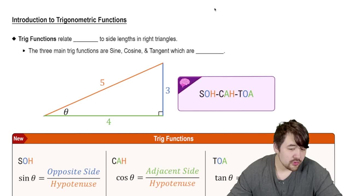
Trigonometric functions, such as sine and cosine, are periodic functions that arise in various mathematical contexts, including calculus. Their properties, such as periodicity and symmetry, play a crucial role in integration, especially when dealing with integrals involving trigonometric expressions.
Recommended video:
6:04
Introduction to Trigonometric Functions