
Ch. 4 - Applications of the Derivative
Briggs - Calculus: Early Transcendentals 3rd Edition
Briggs3rd EditionCalculus: Early TranscendentalsISBN: 9780136847243Not the one you use?Change textbook
Chapter 4, Problem 4.7.20

Evaluate the following limits. Use l’Hôpital’s Rule when it is convenient and applicable.


lim_x→ 0 (eˣ - 1) / (2x + 5)

Verified step by step guidance
1
First, substitute x = 0 into the limit expression to check if it results in an indeterminate form. The expression becomes (e^0 - 1) / (2*0 + 5), which simplifies to 0/5 = 0. Since this is not an indeterminate form, l'Hôpital's Rule is not necessary.
Since the limit does not result in an indeterminate form, evaluate the expression directly by substituting x = 0. The expression becomes (e^0 - 1) / (2*0 + 5).
Simplify the expression: e^0 is 1, so the numerator becomes 1 - 1 = 0. The denominator is 2*0 + 5 = 5.
The limit simplifies to 0/5, which is 0.
Thus, the limit of (eˣ - 1) / (2x + 5) as x approaches 0 is 0.

Verified video answer for a similar problem:

This video solution was recommended by our tutors as helpful for the problem above.
Video duration:
1m
Was this helpful?

Key Concepts

Here are the essential concepts you must grasp in order to answer the question correctly.

Limits

A limit is a fundamental concept in calculus that describes the behavior of a function as its input approaches a certain value. It helps in understanding the function's behavior near points of interest, including points where the function may not be explicitly defined. Evaluating limits is essential for determining continuity, derivatives, and integrals.
Recommended video:
05:50
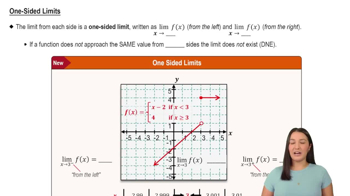
One-Sided Limits

l'Hôpital's Rule

l'Hôpital's Rule is a method used to evaluate limits that result in indeterminate forms, such as 0/0 or ∞/∞. The rule states that if the limit of f(x)/g(x) leads to an indeterminate form, the limit can be found by taking the derivative of the numerator and the derivative of the denominator separately, and then re-evaluating the limit. This technique simplifies the process of finding limits in complex scenarios.
Recommended video:

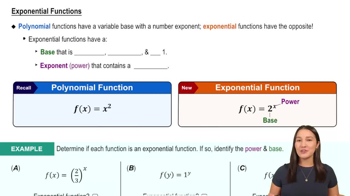
Exponential Functions

Exponential functions, such as eˣ, are functions where a constant base is raised to a variable exponent. They are crucial in calculus due to their unique properties, including their continuous growth and the fact that the derivative of eˣ is eˣ itself. Understanding the behavior of exponential functions near specific points, like x = 0, is vital for evaluating limits involving these functions.
Recommended video:
6:13
Exponential Functions