
Textbook Question
Differentials Consider the following functions and express the relationship between a small change in x and the corresponding change in y in the form dy = f'(x)dx.
f(x) = sin⁻¹ x

 Verified step by step guidance
 05:04
05:04
 06:07
06:07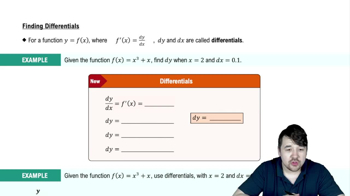 05:53
05:53Differentials Consider the following functions and express the relationship between a small change in x and the corresponding change in y in the form dy = f'(x)dx.
f(x) = sin⁻¹ x
Snell’s Law Suppose a light source at A is in a medium in which light travels at a speed v₁ and that point B is in a medium in which light travels at a speed v₂ (see figure). Using Fermat’s Principle, which states that light travels along the path that requires the minimum travel time (Exercise 55), show that the path taken between points A and B satisfies (sinΘ₁/v₁ = (sin Θ₂) /v₂ . <IMAGE>
Evaluate the following limits. Use l’Hôpital’s Rule when it is convenient and applicable.
lim_x→ 1 (x² + 2x) / (x +3)
17–83. Limits Evaluate the following limits. Use l’Hôpital’s Rule when it is convenient and applicable.
lim_x→ 0 (eˣ - sin x - 1) / (x⁴ + 8x³ + 12x²)
Differentials Consider the following functions and express the relationship between a small change in x and the corresponding change in y in the form dy = f'(x)dx.
f(x) = tan x
Evaluate the following limits. Use l’Hôpital’s Rule when it is convenient and applicable.
lim_x→ 0 (eˣ - 1) / (2x + 5)