Ch. 3 - Derivatives
Briggs - Calculus: Early Transcendentals 3rd Edition
Briggs3rd EditionCalculus: Early TranscendentalsISBN: 9780136847243Not the one you use?Change textbook
Chapter 3, Problem 114

Water flows into a conical tank at a rate of 2 ft³/min. If the radius of the top of the tank is 4 ft and the height is 6 ft, determine how quickly the water level is rising when the water is 2 ft deep in the tank.

Verified step by step guidance
1
First, understand the relationship between the volume of the cone and its dimensions. The formula for the volume of a cone is V = (1/3)πr²h, where r is the radius and h is the height.
Since the tank is conical, the radius of the water level changes as the water level rises. Use similar triangles to express the radius of the water level in terms of the height of the water. The ratio of the radius to the height of the cone is constant: r/h = 4/6 = 2/3.
Express the radius of the water level in terms of the height of the water: r = (2/3)h.
Substitute r = (2/3)h into the volume formula to express the volume in terms of h: V = (1/3)π((2/3)h)²h = (4/27)πh³.
Differentiate the volume with respect to time to find the rate at which the water level is rising. Use the chain rule: dV/dt = (dV/dh)(dh/dt). Given dV/dt = 2 ft³/min, solve for dh/dt when h = 2 ft.

Verified video answer for a similar problem:

This video solution was recommended by our tutors as helpful for the problem above.
Video duration:
4m
Was this helpful?

Key Concepts

Here are the essential concepts you must grasp in order to answer the question correctly.

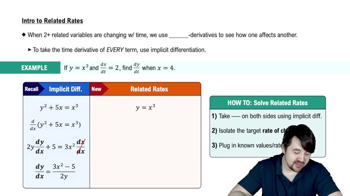
Related Rates

Related rates involve finding the rate at which one quantity changes in relation to another. In this problem, we need to relate the volume of water in the conical tank to the height of the water, using the concept of derivatives to express how the volume changes with respect to time as the height of the water changes.
Recommended video:
04:16
Intro To Related Rates

Volume of a Cone

The volume of a cone is given by the formula V = (1/3)πr²h, where r is the radius of the base and h is the height. In this scenario, as water fills the conical tank, both the radius and height of the water change, and we need to express the volume in terms of the water height to apply related rates effectively.
Recommended video:
08:29
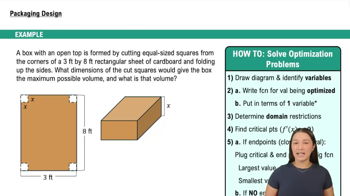
Example 5: Packaging Design

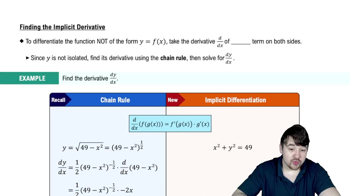
Implicit Differentiation

Implicit differentiation is a technique used to differentiate equations that define one variable in terms of another without explicitly solving for one variable. In this problem, we will differentiate the volume formula with respect to time to find the rate of change of height as the volume of water increases, allowing us to determine how quickly the water level is rising.
Recommended video:
05:14
Finding The Implicit Derivative