Ch. 3 - Derivatives
Briggs - Calculus: Early Transcendentals 3rd Edition
Briggs3rd EditionCalculus: Early TranscendentalsISBN: 9780136847243Not the one you use?Change textbook
Chapter 3, Problem 107b

Suppose the cost of producing x lawn mowers is C(x) = −0.02x²+400x+5000. 
b. Interpret the meaning of your results in part (a).

Verified step by step guidance
1
To interpret the meaning of the results from part (a), we first need to understand the function C(x) = −0.02x² + 400x + 5000. This function represents the cost of producing x lawn mowers.
The term −0.02x² indicates that the cost function is quadratic, and the negative coefficient suggests that the cost increases at a decreasing rate as more lawn mowers are produced. This is typical of economies of scale where producing more units can reduce the average cost per unit.
The term 400x represents the linear component of the cost function, which implies that there is a direct cost associated with each lawn mower produced. This could include materials, labor, and other variable costs.
The constant term 5000 represents fixed costs, which are costs that do not change with the number of lawn mowers produced. These could include rent, salaries of permanent staff, and other overheads.
In part (a), you likely found the derivative of C(x) to determine the marginal cost, which is the cost of producing one additional lawn mower. Interpreting this result helps understand how the cost changes with production levels and can inform decisions on optimal production quantities.

Verified video answer for a similar problem:

This video solution was recommended by our tutors as helpful for the problem above.
Video duration:
5m
Was this helpful?

Key Concepts

Here are the essential concepts you must grasp in order to answer the question correctly.

Cost Function

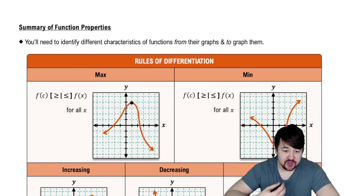
A cost function, such as C(x) = -0.02x² + 400x + 5000, represents the total cost of producing a certain number of goods, in this case, lawn mowers. It typically includes fixed costs and variable costs, where the quadratic term indicates that costs may increase at a decreasing rate after a certain production level.
Recommended video:
06:21
Properties of Functions

Derivative and Marginal Cost

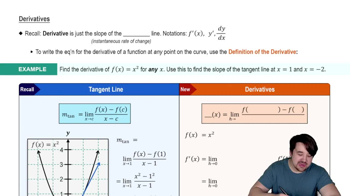
The derivative of the cost function, C'(x), provides the marginal cost, which is the cost of producing one additional unit. Understanding this concept is crucial for interpreting how production levels affect costs and for making decisions about scaling production.
Recommended video:
05:44
Derivatives

Interpretation of Results

Interpreting results involves analyzing the output from the cost function and its derivative to understand the economic implications. This includes assessing how changes in production volume impact overall costs and profitability, which is essential for making informed business decisions.
Recommended video:
04:22
Integrals Resulting in Basic Trig Functions Example 1