Ch. 3 - Derivatives
Briggs - Calculus: Early Transcendentals 3rd Edition
Briggs3rd EditionCalculus: Early TranscendentalsISBN: 9780136847243Not the one you use?Change textbook
Chapter 3, Problem 3.5.13

Use Theorem 3.10 to evaluate the following limits.
lim x🠂0 (sin 7x) / 3x

Verified step by step guidance
1
Identify Theorem 3.10, which is the standard limit \( \lim_{x \to 0} \frac{\sin x}{x} = 1 \). This theorem is useful for evaluating limits involving sine functions as \( x \) approaches zero.
Rewrite the given limit \( \lim_{x \to 0} \frac{\sin 7x}{3x} \) in a form that allows the use of Theorem 3.10. Notice that the argument of the sine function is \( 7x \), not \( x \).
To apply Theorem 3.10, we need the expression inside the sine function to match the denominator. Rewrite the limit as \( \lim_{x \to 0} \frac{7}{3} \cdot \frac{\sin 7x}{7x} \).
Recognize that \( \frac{\sin 7x}{7x} \) is in the form required by Theorem 3.10, so \( \lim_{x \to 0} \frac{\sin 7x}{7x} = 1 \).
Combine the results to find the limit: \( \lim_{x \to 0} \frac{7}{3} \cdot 1 = \frac{7}{3} \). Thus, the limit is \( \frac{7}{3} \).

Verified video answer for a similar problem:

This video solution was recommended by our tutors as helpful for the problem above.
Video duration:
7m
Was this helpful?

Key Concepts

Here are the essential concepts you must grasp in order to answer the question correctly.

Theorem 3.10 (Limit of Sin Function)

Theorem 3.10 typically refers to the limit property that states lim (x→0) (sin(kx)/x) = k for any constant k. This theorem is crucial for evaluating limits involving sine functions, as it provides a straightforward way to simplify expressions as x approaches zero.
Recommended video:
06:11
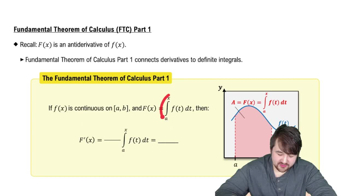
Fundamental Theorem of Calculus Part 1

Limit Evaluation

Limit evaluation is a fundamental concept in calculus that involves determining the value that a function approaches as the input approaches a certain point. In this case, we are interested in the behavior of the function (sin 7x)/(3x) as x approaches 0, which requires applying limit properties and potentially L'Hôpital's Rule if the limit results in an indeterminate form.
Recommended video:
05:50
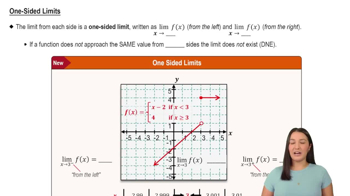
One-Sided Limits

Indeterminate Forms

Indeterminate forms occur when direct substitution in a limit leads to expressions like 0/0 or ∞/∞. In the given limit, substituting x = 0 results in the form 0/0, which necessitates further analysis using limit theorems or algebraic manipulation to resolve the limit correctly.
Recommended video:
Guided course
3:56
Slope-Intercept Form