Ch. 3 - Derivatives
Briggs - Calculus: Early Transcendentals 3rd Edition
Briggs3rd EditionCalculus: Early TranscendentalsISBN: 9780136847243Not the one you use?Change textbook
Chapter 3, Problem 3.4.26

Derivatives Find and simplify the derivative of the following functions.
f(x) = 2e^x-1 / 2e^x+1

Verified step by step guidance
1
Step 1: Identify the function f(x) = \(\frac{2e^x - 1}{2e^x + 1}\). This is a rational function, which means we will use the quotient rule to find its derivative.
Step 2: Recall the quotient rule for derivatives: if you have a function \( g(x) = \frac{u(x)}{v(x)} \), then the derivative \( g'(x) \) is given by \( \frac{u'(x)v(x) - u(x)v'(x)}{(v(x))^2} \).
Step 3: Assign \( u(x) = 2e^x - 1 \) and \( v(x) = 2e^x + 1 \). Compute the derivatives: \( u'(x) = 2e^x \) and \( v'(x) = 2e^x \).
Step 4: Substitute \( u(x) \), \( v(x) \), \( u'(x) \), and \( v'(x) \) into the quotient rule formula: \( f'(x) = \frac{(2e^x)(2e^x + 1) - (2e^x - 1)(2e^x)}{(2e^x + 1)^2} \).
Step 5: Simplify the expression obtained in Step 4 by expanding the terms in the numerator and combining like terms.

Verified video answer for a similar problem:

This video solution was recommended by our tutors as helpful for the problem above.
Video duration:
4m
Was this helpful?

Key Concepts

Here are the essential concepts you must grasp in order to answer the question correctly.

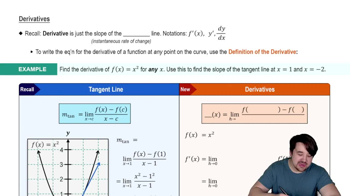
Derivatives

A derivative represents the rate at which a function changes at any given point. It is defined as the limit of the average rate of change of the function as the interval approaches zero. In calculus, derivatives are fundamental for understanding the behavior of functions, including their slopes and rates of change.
Recommended video:
05:44
Derivatives

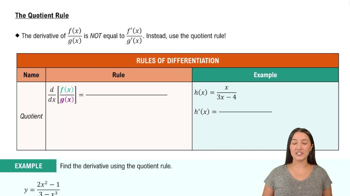
Quotient Rule

The Quotient Rule is a formula used to find the derivative of a function that is the ratio of two other functions. If f(x) = g(x)/h(x), the derivative f'(x) is given by (g'(x)h(x) - g(x)h'(x)) / (h(x))^2. This rule is essential when differentiating functions that are expressed as fractions.
Recommended video:
06:43
The Quotient Rule

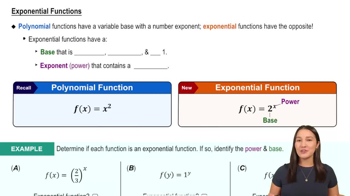
Exponential Functions

Exponential functions are mathematical functions of the form f(x) = a * e^(bx), where e is the base of the natural logarithm. These functions are characterized by their constant rate of growth or decay, making them crucial in various applications, including calculus. Understanding their derivatives involves recognizing that the derivative of e^(x) is e^(x), which simplifies calculations.
Recommended video:
6:13
Exponential Functions