Ch. 3 - Derivatives
Briggs - Calculus: Early Transcendentals 3rd Edition
Briggs3rd EditionCalculus: Early TranscendentalsISBN: 9780136847243Not the one you use?Change textbook
Chapter 3, Problem 3.6.9

The speed of sound (in m/s) in dry air is approximated the function v(T) = 331 + 0.6T, where T is the air temperature (in degrees Celsius). Evaluate v' (T) and interpret its meaning.

Verified step by step guidance
1
Step 1: Identify the given function v(T) = 331 + 0.6T, which represents the speed of sound in dry air as a function of temperature T.
Step 2: Recognize that v'(T) represents the derivative of the function v(T) with respect to T, which gives the rate of change of the speed of sound with respect to temperature.
Step 3: Differentiate the function v(T) = 331 + 0.6T with respect to T. Since 331 is a constant, its derivative is 0. The derivative of 0.6T with respect to T is 0.6.
Step 4: Conclude that v'(T) = 0.6. This means that for each degree Celsius increase in temperature, the speed of sound increases by 0.6 meters per second.
Step 5: Interpret the result: The derivative v'(T) = 0.6 indicates that the speed of sound in dry air increases linearly with temperature at a constant rate of 0.6 m/s per degree Celsius.

Verified video answer for a similar problem:

This video solution was recommended by our tutors as helpful for the problem above.
Video duration:
2m
Was this helpful?

Key Concepts

Here are the essential concepts you must grasp in order to answer the question correctly.

Derivative

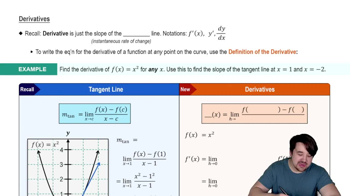
The derivative of a function measures the rate at which the function's value changes as its input changes. In this context, v'(T) represents the rate of change of the speed of sound with respect to temperature. It provides insight into how sensitive the speed of sound is to variations in temperature.
Recommended video:
05:44
Derivatives

Function Interpretation

Understanding the function v(T) = 331 + 0.6T involves recognizing that it is a linear function where the speed of sound increases with temperature. The constant 331 m/s represents the speed of sound at 0 degrees Celsius, while the coefficient 0.6 indicates the increase in speed for each degree rise in temperature.
Recommended video:
04:39
Derivative of the Natural Logarithmic Function Example 7

Physical Context of Derivatives

In physics, derivatives often have practical interpretations. For this problem, v'(T) not only quantifies how the speed of sound changes with temperature but also reflects the physical phenomenon that sound travels faster in warmer air. This relationship is crucial for applications in meteorology and acoustics.
Recommended video:
05:44
Derivatives