
Textbook Question
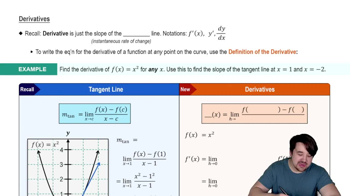
Derivatives Find the derivative of the following functions. See Example 2 of Section 3.2 for the derivative of √x.
h(t) = t²/2 + 1
2
views

 Verified step by step guidance
 05:44
05:44
 05:18
05:18 6:13
6:13Derivatives Find the derivative of the following functions. See Example 2 of Section 3.2 for the derivative of √x.
h(t) = t²/2 + 1
Another method for proving lim x→0 cos x−1/x = 0 Use the half-angle formula sin²x = 1− cos 2x/2 to prove that lim x→0 cos x−1/x=0.
The line tangent to the graph of f at x=5 is y = 1/10x-2. Find d/dx (4f(x)) |x+5
90–93. {Use of Tech} Work carefully Proceed with caution when using implicit differentiation to find points at which a curve has a specified slope. For the following curves, find the points on the curve (if they exist) at which the tangent line is horizontal or vertical. Once you have found possible points, make sure that they actually lie on the curve. Confirm your results with a graph.
x²(3y²−2y³) = 4
The speed of sound (in m/s) in dry air is approximated the function v(T) = 331 + 0.6T, where T is the air temperature (in degrees Celsius). Evaluate v' (T) and interpret its meaning.
73–78. {Use of Tech} Normal lines A normal line at a point P on a curve passes through P and is perpendicular to the line tangent to the curve at P (see figure). Use the following equations and graphs to determine an equation of the normal line at the given point. Illustrate your work by graphing the curve with the normal line. <IMAGE>
Exercise 48