Ch. 3 - Derivatives
Briggs - Calculus: Early Transcendentals 3rd Edition
Briggs3rd EditionCalculus: Early TranscendentalsISBN: 9780136847243Not the one you use?Change textbook
Chapter 3, Problem 35c

Determine whether the following statements are true and give an explanation or counterexample.
c. It is impossible for the instantaneous velocity at all times a≤t≤b to equal the average velocity over the interval a≤t≤b.

Verified step by step guidance
1
To determine if the statement is true, we need to understand the concepts of instantaneous velocity and average velocity. Instantaneous velocity is the velocity of an object at a specific moment in time, while average velocity is the total displacement divided by the total time over an interval.
Consider a scenario where an object moves with constant velocity. In this case, the instantaneous velocity at any time \( t \) within the interval \( a \leq t \leq b \) is the same as the constant velocity.
For constant velocity, the average velocity over the interval \( a \leq t \leq b \) is calculated as the total displacement divided by the total time, which is equal to the constant velocity itself.
Thus, if the object moves with constant velocity, the instantaneous velocity at all times \( a \leq t \leq b \) is equal to the average velocity over the interval.
Therefore, the statement is false. A counterexample is an object moving with constant velocity, where the instantaneous velocity at all times equals the average velocity over the interval.

Verified video answer for a similar problem:

This video solution was recommended by our tutors as helpful for the problem above.
Video duration:
5m
Was this helpful?

Key Concepts

Here are the essential concepts you must grasp in order to answer the question correctly.

Instantaneous Velocity

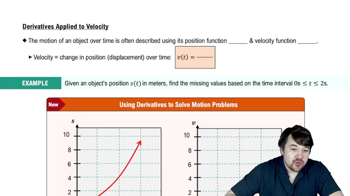
Instantaneous velocity refers to the velocity of an object at a specific moment in time. It is defined mathematically as the limit of the average velocity as the time interval approaches zero. This concept is crucial for understanding how an object's speed changes at any given point, and it is represented by the derivative of the position function with respect to time.
Recommended video:
06:29
Derivatives Applied To Velocity

Average Velocity

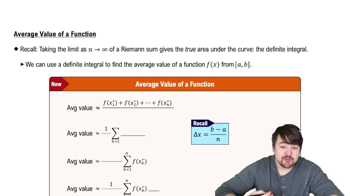
Average velocity is defined as the total displacement divided by the total time taken over a specific interval. It provides a measure of the overall change in position of an object during that interval. The average velocity can be calculated using the formula (s(b) - s(a)) / (b - a), where s(t) is the position function at times a and b.
Recommended video:
06:37
Average Value of a Function

Mean Value Theorem

The Mean Value Theorem states that if a function is continuous on a closed interval [a, b] and differentiable on the open interval (a, b), then there exists at least one point c in (a, b) where the instantaneous velocity (the derivative) equals the average velocity over that interval. This theorem is essential for understanding the relationship between instantaneous and average velocities, and it provides a counterexample to the statement in the question.
Recommended video:
06:11
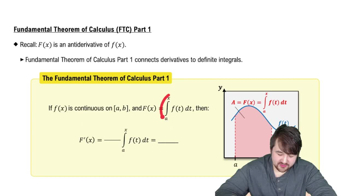
Fundamental Theorem of Calculus Part 1