Ch. 3 - Derivatives
Briggs - Calculus: Early Transcendentals 3rd Edition
Briggs3rd EditionCalculus: Early TranscendentalsISBN: 9780136847243Not the one you use?Change textbook
Chapter 3, Problem 36

A feather dropped on the moon On the moon, a feather will fall to the ground at the same rate as a heavy stone. Suppose a feather is dropped from a height of 40 m above the surface of the moon. Its height (in meters) above the ground after t seconds is s = 40−0.8t². Determine the velocity and acceleration of the feather the moment it strikes the surface of the moon.

Verified step by step guidance
1
Step 1: Identify the function for the height of the feather, which is given as s(t) = 40 - 0.8t^2, where s is the height in meters and t is the time in seconds.
Step 2: To find the velocity of the feather, take the first derivative of the height function s(t) with respect to time t. This will give you the velocity function v(t).
Step 3: Calculate the first derivative: v(t) = ds/dt = d/dt (40 - 0.8t^2).
Step 4: To find the acceleration of the feather, take the second derivative of the height function s(t) with respect to time t. This will give you the acceleration function a(t).
Step 5: Calculate the second derivative: a(t) = d^2s/dt^2 = d/dt (v(t)).

Verified video answer for a similar problem:

This video solution was recommended by our tutors as helpful for the problem above.
Video duration:
5m
Was this helpful?

Key Concepts

Here are the essential concepts you must grasp in order to answer the question correctly.

Kinematics

Kinematics is the branch of mechanics that describes the motion of objects without considering the forces that cause the motion. It involves concepts such as displacement, velocity, and acceleration. In this context, the height function s = 40 - 0.8t² represents the position of the feather over time, allowing us to analyze its motion as it falls.

Velocity

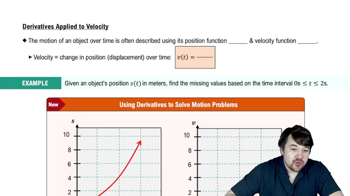
Velocity is a vector quantity that refers to the rate of change of an object's position with respect to time. It is calculated as the derivative of the position function. For the feather, we can find its velocity by differentiating the height function s with respect to time t, which will give us the speed and direction of the feather just before it hits the moon's surface.
Recommended video:
06:29
Derivatives Applied To Velocity

Acceleration

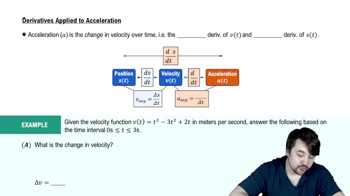
Acceleration is the rate of change of velocity with respect to time and is also a vector quantity. In this scenario, the feather experiences constant acceleration due to gravity on the moon, which is represented by the coefficient of t² in the height equation. By differentiating the velocity function, we can determine the feather's acceleration at the moment it strikes the surface.
Recommended video:
06:15
Derivatives Applied To Acceleration