Ch. 3 - Derivatives
Briggs - Calculus: Early Transcendentals 3rd Edition
Briggs3rd EditionCalculus: Early TranscendentalsISBN: 9780136847243Not the one you use?Change textbook
Chapter 3, Problem 87d

Determine whether the following statements are true and give an explanation or counterexample.
d/dx((√2)x) = x(√2)x - 1

Verified step by step guidance
1
Step 1: Recognize the function given is \( f(x) = (\sqrt{2})^x \). This is an exponential function where the base is \( \sqrt{2} \).
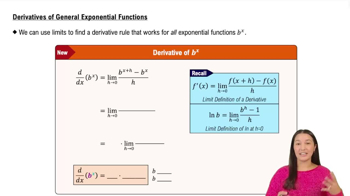
Step 2: Recall the derivative rule for exponential functions of the form \( a^x \), which is \( \frac{d}{dx}(a^x) = a^x \ln(a) \).
Step 3: Apply the derivative rule to \( f(x) = (\sqrt{2})^x \). The derivative is \( (\sqrt{2})^x \ln(\sqrt{2}) \).
Step 4: Compare the derived expression \( (\sqrt{2})^x \ln(\sqrt{2}) \) with the given expression \( x(\sqrt{2})^{x-1} \).
Step 5: Conclude that the given statement is false because \( (\sqrt{2})^x \ln(\sqrt{2}) \neq x(\sqrt{2})^{x-1} \). The correct derivative involves the natural logarithm of the base, not a multiplication by \( x \).

Verified video answer for a similar problem:

This video solution was recommended by our tutors as helpful for the problem above.
Video duration:
2m
Was this helpful?

Key Concepts

Here are the essential concepts you must grasp in order to answer the question correctly.

Derivative of Exponential Functions

The derivative of an exponential function of the form a^x, where a is a constant, is given by d/dx(a^x) = a^x * ln(a). This rule is essential for differentiating functions where the base is a constant raised to a variable exponent, such as (√2)^x.
Recommended video:
04:50
Derivatives of General Exponential Functions

Power Rule

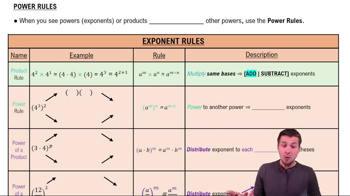
The power rule states that if f(x) = x^n, then f'(x) = n*x^(n-1). This rule is commonly used for differentiating polynomial functions and is not applicable to exponential functions where the base is a constant.
Recommended video:

Counterexamples in Mathematics

A counterexample is a specific case that disproves a general statement. In this context, providing a counterexample to the statement d/dx((√2)^x) = x(√2)^(x - 1) would involve showing that the left-hand side does not equal the right-hand side for any value of x, thus demonstrating the statement's falsehood.
Recommended video:
05:13
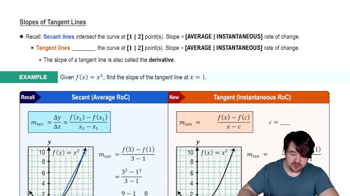
Slopes of Tangent Lines