Ch. 3 - Derivatives
Briggs - Calculus: Early Transcendentals 3rd Edition
Briggs3rd EditionCalculus: Early TranscendentalsISBN: 9780136847243Not the one you use?Change textbook
Chapter 3, Problem 87f

Determine whether the following statements are true and give an explanation or counterexample.
(4x+1)ln x = xln(4x+1)

Verified step by step guidance
1
Step 1: Start by examining the given equation: \((4x+1)^{\ln x} = x^{\ln(4x+1)}\). We need to determine if this equation holds true for all values of \(x\) or if there is a counterexample.
Step 2: Consider taking the natural logarithm of both sides of the equation to simplify the exponents. This gives us \(\ln((4x+1)^{\ln x}) = \ln(x^{\ln(4x+1)})\).
Step 3: Apply the logarithmic identity \(\ln(a^b) = b \cdot \ln a\) to both sides. This results in \(\ln x \cdot \ln(4x+1) = \ln(4x+1) \cdot \ln x\).
Step 4: Notice that both sides of the equation are identical, \(\ln x \cdot \ln(4x+1) = \ln x \cdot \ln(4x+1)\), which suggests that the original equation is true for all \(x > 0\) where the logarithms are defined.
Step 5: Conclude that the statement is true for all \(x > 0\) where both sides of the equation are defined, as the simplification shows both sides are equal.

Verified video answer for a similar problem:

This video solution was recommended by our tutors as helpful for the problem above.
Video duration:
2m
Was this helpful?

Key Concepts

Here are the essential concepts you must grasp in order to answer the question correctly.

Logarithmic Properties

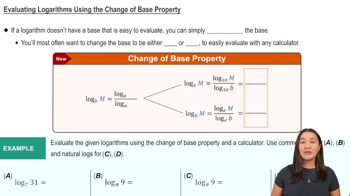
Understanding the properties of logarithms is essential for manipulating expressions involving logarithmic functions. Key properties include the product, quotient, and power rules, which allow us to simplify or transform logarithmic equations. For instance, the power rule states that ln(a^b) = b * ln(a), which can be useful in analyzing the given equation.
Recommended video:
05:36
Change of Base Property

Exponential Functions

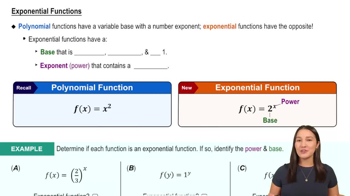
Exponential functions are functions of the form f(x) = a^x, where 'a' is a constant. They exhibit unique properties, such as rapid growth or decay, depending on the base. In the context of the given equation, recognizing how exponential functions relate to logarithmic functions is crucial for determining the validity of the statement.
Recommended video:
6:13
Exponential Functions

Equivalence of Functions

To determine if two expressions are equivalent, one must analyze their behavior across their domains. This involves checking if they yield the same output for all input values. In the case of the given equation, evaluating both sides for specific values of 'x' can help establish whether the statement holds true or if a counterexample exists.
Recommended video:
06:21
Properties of Functions