Ch. 3 - Derivatives
Briggs - Calculus: Early Transcendentals 3rd Edition
Briggs3rd EditionCalculus: Early TranscendentalsISBN: 9780136847243Not the one you use?Change textbook
Chapter 3, Problem 3.26

Derivatives Find the derivative of the following functions. See Example 2 of Section 3.2 for the derivative of √x.
f(v) = v¹⁰⁰+e^v+10

Verified step by step guidance
1
Step 1: Identify the function components. The function f(v) = v^{100} + e^v + 10 consists of three terms: v^{100}, e^v, and 10.
Step 2: Differentiate the first term v^{100}. Use the power rule, which states that the derivative of v^n is n*v^{n-1}. Therefore, the derivative of v^{100} is 100*v^{99}.
Step 3: Differentiate the second term e^v. The derivative of e^v with respect to v is simply e^v, as the exponential function is its own derivative.
Step 4: Differentiate the constant term 10. The derivative of a constant is 0, as constants do not change with respect to the variable.
Step 5: Combine the derivatives of each term. The derivative of the function f(v) is the sum of the derivatives of its individual terms: 100*v^{99} + e^v + 0.

Verified video answer for a similar problem:

This video solution was recommended by our tutors as helpful for the problem above.
Video duration:
4m
Was this helpful?

Key Concepts

Here are the essential concepts you must grasp in order to answer the question correctly.

Derivatives

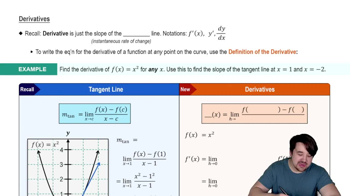
A derivative represents the rate at which a function changes at any given point. It is a fundamental concept in calculus that measures how a function's output value changes as its input value changes. The derivative can be interpreted as the slope of the tangent line to the curve of the function at a specific point.
Recommended video:
05:44
Derivatives

Power Rule

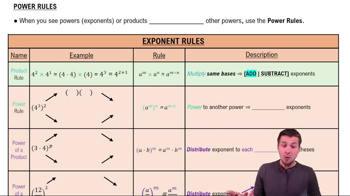
The Power Rule is a basic differentiation rule used to find the derivative of functions of the form f(x) = x^n, where n is a real number. According to this rule, the derivative is given by f'(x) = n*x^(n-1). This rule simplifies the process of differentiating polynomial functions, making it essential for solving problems involving powers of variables.
Recommended video:

Exponential Functions

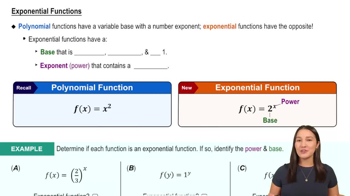
Exponential functions are functions of the form f(x) = e^x, where e is the base of the natural logarithm. The derivative of an exponential function is unique because it is equal to the function itself, meaning f'(x) = e^x. Understanding how to differentiate exponential functions is crucial for solving calculus problems involving growth and decay models.
Recommended video:
6:13
Exponential Functions