Ch. 3 - Derivatives
Briggs - Calculus: Early Transcendentals 3rd Edition
Briggs3rd EditionCalculus: Early TranscendentalsISBN: 9780136847243Not the one you use?Change textbook
Chapter 3, Problem 3.10.71

67–78. Derivatives of inverse functions Consider the following functions (on the given interval, if specified). Find the derivative of the inverse function.


f(x) = e^3x+1

Verified step by step guidance
1
First, understand that if y = f(x) = e^(3x+1), then the inverse function, denoted as f^(-1)(y), is the function that satisfies x = f^(-1)(y).
To find the derivative of the inverse function, we use the formula: (f^(-1))'(y) = 1 / f'(x), where x = f^(-1)(y).
Calculate the derivative of the original function f(x) = e^(3x+1). Using the chain rule, the derivative f'(x) = 3e^(3x+1).
Substitute f'(x) into the inverse derivative formula: (f^(-1))'(y) = 1 / (3e^(3x+1)).
Since y = e^(3x+1), solve for x in terms of y to express x = f^(-1)(y). Then substitute this expression for x back into the formula for (f^(-1))'(y) to find the derivative of the inverse function in terms of y.

Verified video answer for a similar problem:

This video solution was recommended by our tutors as helpful for the problem above.
Video duration:
3m
Was this helpful?

Key Concepts

Here are the essential concepts you must grasp in order to answer the question correctly.

Inverse Functions

An inverse function essentially reverses the effect of the original function. If a function f takes an input x and produces an output y, the inverse function f⁻¹ takes y back to x. Understanding how to find and work with inverse functions is crucial for solving problems involving derivatives of these functions.
Recommended video:
4:49
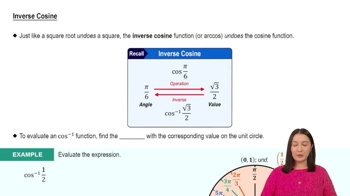
Inverse Cosine

Derivative of a Function

The derivative of a function measures how the function's output changes as its input changes. It is a fundamental concept in calculus that provides information about the slope of the function at any given point. For the function f(x) = e^(3x+1), finding its derivative is the first step in determining the derivative of its inverse.
Recommended video:
06:30
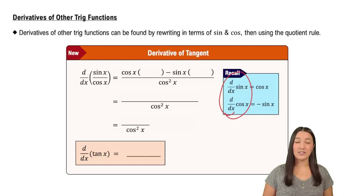
Derivatives of Other Trig Functions

Derivative of Inverse Functions Formula

The derivative of an inverse function can be found using the formula (f⁻¹)'(y) = 1 / f'(x), where y = f(x). This relationship shows that the derivative of the inverse function at a point is the reciprocal of the derivative of the original function at the corresponding point. This concept is essential for calculating the derivative of the inverse function in the given problem.
Recommended video:
07:26
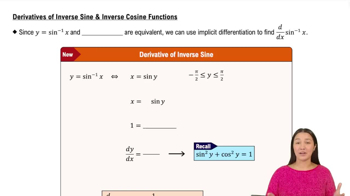
Derivatives of Inverse Sine & Inverse Cosine