Ch. 3 - Derivatives
Briggs - Calculus: Early Transcendentals 3rd Edition
Briggs3rd EditionCalculus: Early TranscendentalsISBN: 9780136847243Not the one you use?Change textbook
Chapter 3, Problem 3.11.26b

A bug is moving along the right side of the parabola y=x² at a rate such that its distance from the origin is increasing at 1 cm/min.
b. Use the equation y=x² to find an equation relating dy/dt to dx/dt.

Verified step by step guidance
1
Start by understanding the problem: We have a bug moving along the parabola y = x², and its distance from the origin is increasing at a rate of 1 cm/min. We need to find a relationship between dy/dt and dx/dt.
Recall that the distance from the origin to a point (x, y) on the parabola is given by the distance formula: d = √(x² + y²). Since y = x², substitute y in the distance formula to get d = √(x² + (x²)²) = √(x² + x⁴).
Differentiate the distance formula with respect to time t to find the rate of change of distance: d(d)/dt = (1/2) * (1/√(x² + x⁴)) * (2x * dx/dt + 4x³ * dx/dt). Set this equal to 1 cm/min, as given in the problem.
Now, differentiate the equation y = x² with respect to time t to find dy/dt: dy/dt = 2x * dx/dt.
Combine the results from the differentiation of the distance formula and the parabola equation to express dy/dt in terms of dx/dt. Use the fact that d(d)/dt = 1 cm/min to solve for dy/dt in terms of dx/dt.

Verified video answer for a similar problem:

This video solution was recommended by our tutors as helpful for the problem above.
Video duration:
5m
Was this helpful?

Key Concepts

Here are the essential concepts you must grasp in order to answer the question correctly.

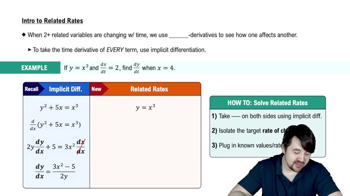
Related Rates

Related rates involve finding the rate at which one quantity changes in relation to another. In this problem, we need to relate the rates of change of the bug's position along the parabola (dx/dt and dy/dt) to its distance from the origin. This concept is essential for setting up the equations that will allow us to solve for the desired rates.
Recommended video:
04:16
Intro To Related Rates

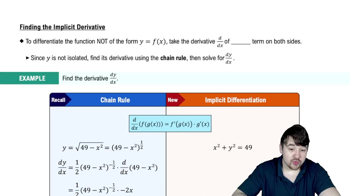
Implicit Differentiation

Implicit differentiation is a technique used to differentiate equations that define y implicitly in terms of x. Since the bug's position is described by the equation y = x², we can differentiate both sides with respect to time t to find a relationship between dy/dt and dx/dt. This method is crucial for relating the rates of change in this context.
Recommended video:
05:14
Finding The Implicit Derivative

Distance Formula

The distance formula calculates the distance between two points in a coordinate system. In this scenario, the distance from the origin to the bug's position on the parabola can be expressed as D = √(x² + y²). Understanding this formula is vital for determining how the distance changes over time, which is central to solving the problem.
Recommended video:
Guided course
5:04
Converting between Degrees & Radians