Ch. 3 - Derivatives
Briggs - Calculus: Early Transcendentals 3rd Edition
Briggs3rd EditionCalculus: Early TranscendentalsISBN: 9780136847243Not the one you use?Change textbook
Chapter 3, Problem 3.7.112b

109-112 {Use of Tech} Calculating limits The following limits are the derivatives of a composite function g at a point a.
b. Use the Chain Rule to find each limit. Verify your answer by using a calculator.
limh013((1+h)5+7)1013(8)10h{\(\displaystyle\]\lim\)_{h\(\to\)0}}\(\frac{\frac{1}{3\left(\left(1+h\right)^5+7\right)^{10}\)}-\(\frac{1}{3\left(8\right)^{10}\)}}{h}

Verified step by step guidance
1
Step 1: Recognize that the given limit represents the derivative of a composite function g at a point a. The expression inside the limit is of the form \( \frac{f(x+h) - f(x)}{h} \), which is the definition of the derivative.
Step 2: Identify the inner function and the outer function. Here, the inner function is \( u(h) = (1+h)^5 + 7 \) and the outer function is \( v(u) = \frac{1}{3u^{10}} \).
Step 3: Apply the Chain Rule to find the derivative. The Chain Rule states that \( \frac{d}{dh} v(u(h)) = v'(u(h)) \cdot u'(h) \).
Step 4: Calculate the derivatives: \( u'(h) = \frac{d}{dh}((1+h)^5 + 7) = 5(1+h)^4 \) and \( v'(u) = \frac{d}{du}(\frac{1}{3u^{10}}) = -\frac{10}{3u^{11}} \).
Step 5: Substitute \( u(h) \) and \( u'(h) \) into the Chain Rule expression: \( \frac{d}{dh} v(u(h)) = -\frac{10}{3((1+h)^5 + 7)^{11}} \cdot 5(1+h)^4 \). Evaluate this expression at \( h = 0 \) to find the limit.

Verified video answer for a similar problem:

This video solution was recommended by our tutors as helpful for the problem above.
Video duration:
6m
Was this helpful?

Key Concepts

Here are the essential concepts you must grasp in order to answer the question correctly.

Limits

Limits are fundamental in calculus, representing the value that a function approaches as the input approaches a certain point. In this context, the limit as h approaches 0 is crucial for determining the derivative of the function at a specific point. Understanding limits allows us to analyze the behavior of functions near points of interest, which is essential for applying the Chain Rule.
Recommended video:
05:50
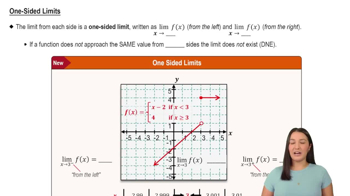
One-Sided Limits

Chain Rule

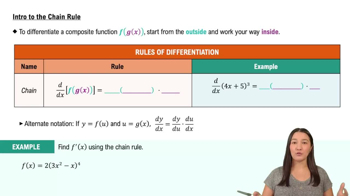
The Chain Rule is a formula for computing the derivative of a composite function. It states that if you have two functions, f(g(x)), the derivative can be found by multiplying the derivative of the outer function f with the derivative of the inner function g. This rule is particularly useful in the given problem, where the limit involves a composite function, allowing for the simplification of the differentiation process.
Recommended video:
05:02
Intro to the Chain Rule

Derivatives

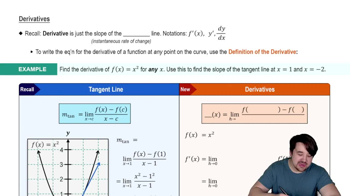
Derivatives represent the rate of change of a function with respect to its variable. They provide information about the slope of the tangent line to the function's graph at a given point. In this question, the limit expression is used to find the derivative of a composite function, which is essential for understanding how the function behaves locally around the point of interest.
Recommended video:
05:44
Derivatives