
Textbook Question
Derivatives of inverse functions from a table Use the following tables to determine the indicated derivatives or state that the derivative cannot be determined. <IMAGE>
c. (f^-1)'(1)

 Verified step by step guidance
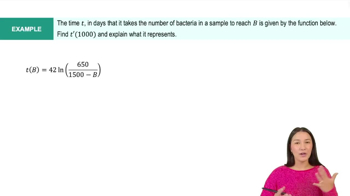
 04:39
04:39
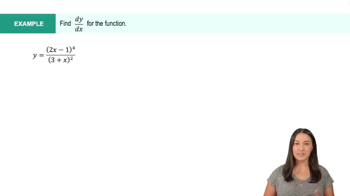 07:39
07:39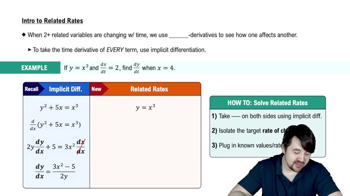 04:16
04:16Derivatives of inverse functions from a table Use the following tables to determine the indicated derivatives or state that the derivative cannot be determined. <IMAGE>
c. (f^-1)'(1)
{Use of Tech} Angle of elevation A small plane, moving at 70 m/s, flies horizontally on a line 400 meters directly above an observer. Let θ be the angle of elevation of the plane (see figure). <IMAGE>
b. Graph dθ/dx as a function of x and determine the point at which θ changes most rapidly.
{Use of Tech} Spring oscillations A spring hangs from the ceiling at equilibrium with a mass attached to its end. Suppose you pull downward on the mass and release it 10 inches below its equilibrium position with an upward push. The distance x (in inches) of the mass from its equilibrium position after t seconds is given by the function x(t) = 10sin t−10cos t, where x is positive when the mass is above the equilibrium position. <IMAGE>
c. At what times is the velocity of the mass zero?
A differential equation is an equation involving an unknown function and its derivatives. Consider the differential equation y′′(t)+y(t) = 0.
b. Show that y = B cos t satisfies the equation for any constant B.
Computing the derivative of f(x) = e^-x
c. Use parts (a) and (b) to find the derivative of f(x) = e^-x.
Use a graphing utility to graph the curve and the tangent line on the same set of axes.
y = (x + 5) / (x - 1); a = 3