A spherical balloon is inflated and its volume increases at a rate of 15 in³/min. What is the rate of change of its radius when the radius is 10 in?

Ch. 3 - Derivatives
Briggs3rd EditionCalculus: Early TranscendentalsISBN: 9780136847243Not the one you use?Change textbook
Chapter 3, Problem 3.8.7
5–8. Calculate dy/dx using implicit differentiation.
sin y+2 = x
Verified step by step guidance1
Start by understanding the equation: \( \sin y + 2 = x \). We need to find \( \frac{dy}{dx} \) using implicit differentiation.
Differentiate both sides of the equation with respect to \( x \). Remember that \( y \) is a function of \( x \), so when differentiating \( \sin y \), use the chain rule.
The derivative of \( \sin y \) with respect to \( x \) is \( \cos y \cdot \frac{dy}{dx} \). The derivative of the constant 2 is 0, and the derivative of \( x \) is 1.
Set up the equation from the differentiation: \( \cos y \cdot \frac{dy}{dx} = 1 \).
Solve for \( \frac{dy}{dx} \) by isolating it: \( \frac{dy}{dx} = \frac{1}{\cos y} \). This is the expression for the derivative using implicit differentiation.

Verified video answer for a similar problem:
This video solution was recommended by our tutors as helpful for the problem above.
Video duration:
1mWas this helpful?
Key Concepts
Here are the essential concepts you must grasp in order to answer the question correctly.
Implicit Differentiation
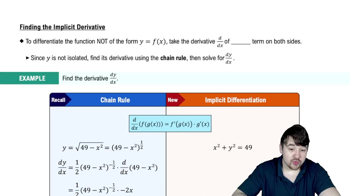
Implicit differentiation is a technique used to find the derivative of a function that is not explicitly solved for one variable in terms of another. Instead of isolating y, we differentiate both sides of the equation with respect to x, applying the chain rule when differentiating terms involving y. This method is particularly useful when dealing with equations where y cannot be easily expressed as a function of x.
Recommended video:
Finding The Implicit Derivative
Chain Rule
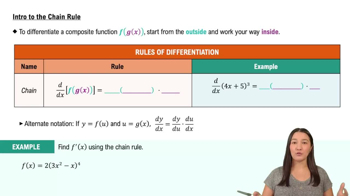
The chain rule is a fundamental principle in calculus that allows us to differentiate composite functions. It states that if a function y is defined as a function of u, which in turn is a function of x, then the derivative of y with respect to x can be found by multiplying the derivative of y with respect to u by the derivative of u with respect to x. This is essential in implicit differentiation when differentiating terms involving y.
Recommended video:
Intro to the Chain Rule
Trigonometric Derivatives
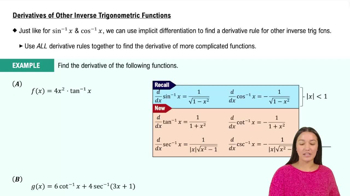
Trigonometric derivatives refer to the derivatives of trigonometric functions, which are essential in calculus. For example, the derivative of sin(y) with respect to x is cos(y) * (dy/dx) due to the chain rule. Understanding these derivatives is crucial when differentiating equations that involve trigonometric functions, as they help in simplifying the expressions and finding the required derivatives.
Recommended video:
Derivatives of Other Inverse Trigonometric Functions
Related Practice
Textbook Question
Textbook Question
Evaluate the following limits or state that they do not exist. (Hint: Identify each limit as the derivative of a function at a point.)
lim x→π/4 cot x−1 / x−π/4
Textbook Question
Derivatives Find and simplify the derivative of the following functions.
g(t) = t³+3t²+t / t³
1
views
Textbook Question
67–78. Derivatives of inverse functions Consider the following functions (on the given interval, if specified). Find the derivative of the inverse function.
f(x) = x^2/3, for x>0
Textbook Question
State the derivative rule for the logarithmic function f(x)=log(subscript b)x. How does it differ from the derivative formula for ln x?
2
views
Textbook Question
Complete the following statement. If dy/dx is small, then small changes in x will result in relatively ______ changes in the value of y.