Ch. 2 - Limits
Briggs - Calculus: Early Transcendentals 3rd Edition
Briggs3rd EditionCalculus: Early TranscendentalsISBN: 9780136847243Not the one you use?Change textbook
Chapter 2, Problem 2.7.47

Use the precise definition of infinite limits to prove the following limits.


limx0(1x2+1)={\(\displaystyle\]\lim\)_{x\(\to\)0}}\(\left\)(\(\frac{1}{x^2}\)+1\(\right\))=\(\infty\)

Verified step by step guidance
1
Step 1: Understand the definition of an infinite limit. The limit of a function f(x) as x approaches a value c is infinity if for every positive number M, there exists a δ > 0 such that if 0 < |x - c| < δ, then f(x) > M.
Step 2: Identify the function and the point of interest. Here, the function is f(x) = \( \frac{1}{x^2} + 1 \) and we are interested in the behavior as x approaches 0.
Step 3: Set up the inequality based on the definition. We need to show that for every M > 0, there exists a δ > 0 such that if 0 < |x| < δ, then \( \frac{1}{x^2} + 1 > M \).
Step 4: Simplify the inequality \( \frac{1}{x^2} + 1 > M \) to \( \frac{1}{x^2} > M - 1 \). This implies \( x^2 < \frac{1}{M - 1} \) and thus |x| < \( \frac{1}{\sqrt{M - 1}} \).
Step 5: Choose δ = \( \frac{1}{\sqrt{M - 1}} \). This choice of δ ensures that whenever 0 < |x| < δ, the inequality \( \frac{1}{x^2} + 1 > M \) holds, proving the limit is infinity.

Verified video answer for a similar problem:

This video solution was recommended by our tutors as helpful for the problem above.
Video duration:
6m
Was this helpful?

Key Concepts

Here are the essential concepts you must grasp in order to answer the question correctly.

Infinite Limits

Infinite limits occur when the value of a function increases without bound as the input approaches a certain point. In this context, we analyze the behavior of the function as x approaches 0. If the function's value grows larger and larger, we denote this behavior as approaching infinity, which is a key aspect of understanding limits in calculus.
Recommended video:
05:50
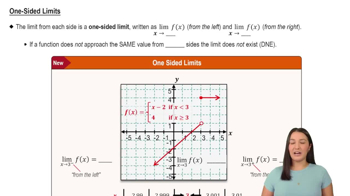
One-Sided Limits

Limit Definition

The precise definition of a limit involves the concept of epsilon (ε) and delta (δ). For a limit to equal L as x approaches a value c, for every ε > 0, there exists a δ > 0 such that if 0 < |x - c| < δ, then |f(x) - L| < ε. This formal definition helps in rigorously proving the behavior of functions near specific points, especially when dealing with infinite limits.
Recommended video:
05:43
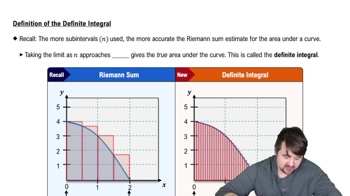
Definition of the Definite Integral

Behavior of Rational Functions

Rational functions are ratios of polynomials, and their behavior near certain points can lead to infinite limits. In the given limit, as x approaches 0, the term 1/x² dominates the expression, leading to an increase towards infinity. Understanding how the numerator and denominator interact as x approaches critical values is essential for analyzing limits effectively.
Recommended video:
6:04
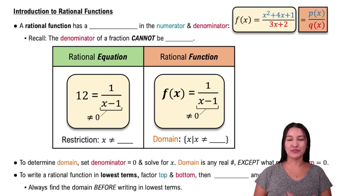
Intro to Rational Functions