Ch. 2 - Limits
Briggs - Calculus: Early Transcendentals 3rd Edition
Briggs3rd EditionCalculus: Early TranscendentalsISBN: 9780136847243Not the one you use?Change textbook
Chapter 2, Problem 2.2.25

Sketch a graph of f and use it to make a conjecture about the values of f(a), lim x→a^−f(x),lim x→a^+f(x), and lim x→a f(x) or state that they do not exist.
f(x) = x^2+x−2 / x−1; a=1

Verified step by step guidance
1
Step 1: Identify the function and the point of interest. The function given is \( f(x) = \frac{x^2 + x - 2}{x - 1} \) and we are interested in the behavior around \( a = 1 \).
Step 2: Simplify the function if possible. Factor the numerator \( x^2 + x - 2 \) to see if it can be simplified with the denominator. The numerator factors as \( (x - 1)(x + 2) \), so \( f(x) = \frac{(x - 1)(x + 2)}{x - 1} \).
Step 3: Analyze the simplified function. The \( x - 1 \) terms cancel out, leaving \( f(x) = x + 2 \) for \( x \neq 1 \). This indicates a removable discontinuity at \( x = 1 \).
Step 4: Determine the limits. Since \( f(x) = x + 2 \) for \( x \neq 1 \), calculate \( \lim_{x \to 1^-} f(x) \) and \( \lim_{x \to 1^+} f(x) \) by substituting \( x = 1 \) into \( x + 2 \), which gives the same value from both sides.
Step 5: Conjecture about \( f(a) \) and \( \lim_{x \to a} f(x) \). Since the limit from both sides is the same, \( \lim_{x \to 1} f(x) \) exists and equals the value found in Step 4. However, \( f(1) \) is undefined in the original function due to division by zero, indicating a removable discontinuity.

Verified video answer for a similar problem:

This video solution was recommended by our tutors as helpful for the problem above.
Video duration:
6m
Was this helpful?

Key Concepts

Here are the essential concepts you must grasp in order to answer the question correctly.

Limits

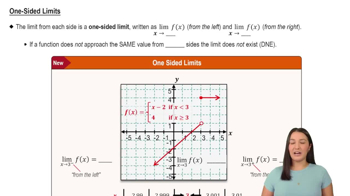
Limits describe the behavior of a function as the input approaches a certain value. In this context, we analyze the left-hand limit (lim x→a^−f(x)) and the right-hand limit (lim x→a^+f(x)) as x approaches 1. Understanding limits is crucial for determining the continuity and behavior of the function at that point.
Recommended video:
05:50
One-Sided Limits

Continuity

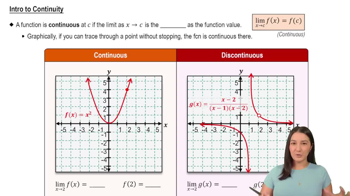
A function is continuous at a point if the limit as x approaches that point equals the function's value at that point. For the function f(x) = (x^2 + x - 2) / (x - 1), we need to check if f(1) exists and if it matches the limits from both sides. If the limits do not match or if f(1) is undefined, the function is not continuous at x = 1.
Recommended video:
05:34
Intro to Continuity

Graphing Rational Functions

Graphing rational functions involves identifying asymptotes, intercepts, and the overall shape of the graph. For f(x) = (x^2 + x - 2) / (x - 1), we can factor the numerator to find zeros and analyze the vertical asymptote at x = 1. This visual representation helps in making conjectures about the function's behavior near the point of interest.
Recommended video:
5:53
Graph of Sine and Cosine Function