Ch. 2 - Limits
Briggs - Calculus: Early Transcendentals 3rd Edition
Briggs3rd EditionCalculus: Early TranscendentalsISBN: 9780136847243Not the one you use?Change textbook
Chapter 2, Problem 2.7.29

Use the precise definition of a limit to prove the following limits. Specify a relationship between ε and δ that guarantees the limit exists.
lim x→2 (x^2+3x)=10

Verified step by step guidance
1
Step 1: Recall the precise definition of a limit. For the limit \( \lim_{x \to a} f(x) = L \) to hold, for every \( \varepsilon > 0 \), there must exist a \( \delta > 0 \) such that if \( 0 < |x - a| < \delta \), then \( |f(x) - L| < \varepsilon \).
Step 2: Identify the function \( f(x) = x^2 + 3x \), the point \( a = 2 \), and the limit \( L = 10 \). We need to show that for every \( \varepsilon > 0 \), there exists a \( \delta > 0 \) such that if \( 0 < |x - 2| < \delta \), then \( |(x^2 + 3x) - 10| < \varepsilon \).
Step 3: Simplify the expression \( |(x^2 + 3x) - 10| \). This becomes \( |x^2 + 3x - 10| \). Factor or simplify this expression to find a form that will help relate \( \varepsilon \) and \( \delta \).
Step 4: Consider the expression \( |x^2 + 3x - 10| \). Rewrite it as \( |(x - 2)(x + 5)| \). We need to ensure that \( |(x - 2)(x + 5)| < \varepsilon \) whenever \( 0 < |x - 2| < \delta \).
Step 5: Establish a relationship between \( \varepsilon \) and \( \delta \). Choose \( \delta \) such that \( |x + 5| \) is bounded when \( x \) is near 2. For instance, if \( |x - 2| < 1 \), then \( 1 < x < 3 \), so \( 6 < x + 5 < 8 \). Use this bound to find a suitable \( \delta \) in terms of \( \varepsilon \).

Verified video answer for a similar problem:

This video solution was recommended by our tutors as helpful for the problem above.
Video duration:
4m
Was this helpful?

Key Concepts

Here are the essential concepts you must grasp in order to answer the question correctly.

Limit Definition

The precise definition of a limit states that for a function f(x) to approach a limit L as x approaches a value a, for every ε > 0, there exists a δ > 0 such that if 0 < |x - a| < δ, then |f(x) - L| < ε. This formalism is essential for rigorously proving limits in calculus.
Recommended video:
05:50
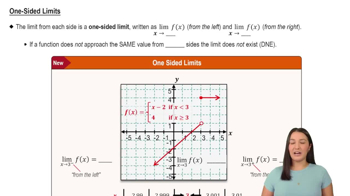
One-Sided Limits

Epsilon-Delta Relationship

In the context of limits, the ε (epsilon) represents how close f(x) must be to the limit L, while δ (delta) represents how close x must be to the point a. Establishing a relationship between ε and δ is crucial for demonstrating that as x gets sufficiently close to a, f(x) will be within ε of L, thus proving the limit exists.
Recommended video:
05:53
Finding Differentials

Polynomial Functions

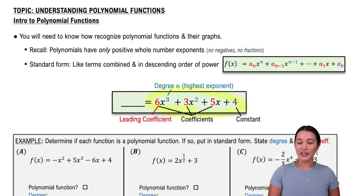
Polynomial functions, such as f(x) = x^2 + 3x, are continuous everywhere on their domain. This continuity implies that limits can often be evaluated by direct substitution. Understanding the behavior of polynomial functions helps in applying the limit definition effectively, especially when proving limits at specific points.
Recommended video:
6:04
Introduction to Polynomial Functions