Ch. 2 - Limits
Briggs - Calculus: Early Transcendentals 3rd Edition
Briggs3rd EditionCalculus: Early TranscendentalsISBN: 9780136847243Not the one you use?Change textbook
Chapter 2, Problem 2.7.44

Suppose limxa f(x)=L{\(\displaystyle\]\lim\)_{x\(\to\) a}}\(\text{ }\)f\(\left\)(x\(\right\))=L. Prove that limxa (c(f(x))=cL{\(\displaystyle\]\lim\)_{x\(\to\) a}}\(\text{ (}\)c\(\left\)(f\(\left\)(x\(\right\))\(\right\))=cL, where cc is a constant.

Verified step by step guidance
1
Start by recalling the definition of a limit: \( \lim_{x \to a} f(x) = L \) means that for every \( \epsilon > 0 \), there exists a \( \delta > 0 \) such that if \( 0 < |x - a| < \delta \), then \( |f(x) - L| < \epsilon \).
To prove \( \lim_{x \to a} (c \cdot f(x)) = cL \), we need to show that for every \( \epsilon > 0 \), there exists a \( \delta > 0 \) such that if \( 0 < |x - a| < \delta \), then \( |c \cdot f(x) - cL| < \epsilon \).
Notice that \( |c \cdot f(x) - cL| = |c| \cdot |f(x) - L| \). We can use the property of absolute values that \( |c| \cdot |f(x) - L| < \epsilon \) if \( |f(x) - L| < \frac{\epsilon}{|c|} \).
Since \( \lim_{x \to a} f(x) = L \), for every \( \epsilon' > 0 \), there exists a \( \delta > 0 \) such that if \( 0 < |x - a| < \delta \), then \( |f(x) - L| < \epsilon' \). Choose \( \epsilon' = \frac{\epsilon}{|c|} \).
Thus, for this choice of \( \epsilon' \), there exists a \( \delta > 0 \) such that if \( 0 < |x - a| < \delta \), then \( |c \cdot f(x) - cL| = |c| \cdot |f(x) - L| < |c| \cdot \frac{\epsilon}{|c|} = \epsilon \). This completes the proof that \( \lim_{x \to a} (c \cdot f(x)) = cL \).

Verified video answer for a similar problem:

This video solution was recommended by our tutors as helpful for the problem above.
Video duration:
3m
Was this helpful?

Key Concepts

Here are the essential concepts you must grasp in order to answer the question correctly.

Limit of a Function

The limit of a function describes the behavior of the function as the input approaches a certain value. Formally, we say that the limit of f(x) as x approaches a is L if, for every small positive number ε, there exists a corresponding small positive number δ such that whenever 0 < |x - a| < δ, it follows that |f(x) - L| < ε. This concept is fundamental in calculus as it lays the groundwork for continuity and differentiability.
Recommended video:
06:11
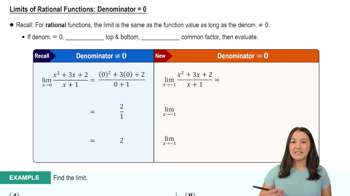
Limits of Rational Functions: Denominator = 0

Constant Multiple Rule

The Constant Multiple Rule states that if a function f(x) approaches a limit L as x approaches a, then the function c*f(x) approaches c*L, where c is a constant. This rule is essential for manipulating limits involving constants and is often used in proofs and calculations to simplify expressions while maintaining their limit properties.
Recommended video:
04:02
The Power Rule

Proof Techniques in Calculus

Proof techniques in calculus often involve epsilon-delta arguments, direct substitution, or algebraic manipulation to establish the validity of limit statements. In the context of limits, proving that the limit of a constant multiplied by a function equals the constant multiplied by the limit of the function requires careful application of these techniques to ensure that all conditions of the limit definition are satisfied.
Recommended video:
06:11
Fundamental Theorem of Calculus Part 1