Ch. 2 - Limits
Briggs - Calculus: Early Transcendentals 3rd Edition
Briggs3rd EditionCalculus: Early TranscendentalsISBN: 9780136847243Not the one you use?Change textbook
Chapter 2, Problem 17d

Use the graph of f in the figure to find the following values or state that they do not exist. If a limit does not exist, explain why. <IMAGE>


d. limx1f(x)\(\lim\)_{x\(\to\)1}f\(\left\)(x\(\right\))

Verified step by step guidance
1
Identify the behavior of the function \( f(x) \) as \( x \) approaches 1 from both the left and the right.
Examine the graph to determine the value that \( f(x) \) approaches as \( x \to 1^- \) (from the left).
Examine the graph to determine the value that \( f(x) \) approaches as \( x \to 1^+ \) (from the right).
Compare the left-hand limit and the right-hand limit. If they are equal, the limit exists and is equal to that common value.
If the left-hand limit and the right-hand limit are not equal, state that the limit does not exist and explain that the function approaches different values from the left and right.

Verified video answer for a similar problem:

This video solution was recommended by our tutors as helpful for the problem above.
Video duration:
2m
Was this helpful?

Key Concepts

Here are the essential concepts you must grasp in order to answer the question correctly.

Limits

A limit describes the behavior of a function as its input approaches a certain value. It is essential for understanding continuity and the behavior of functions near points of interest. For example, the limit of f(x) as x approaches 1 examines the values f(x) takes as x gets closer to 1, which can indicate whether f is defined or behaves predictably at that point.
Recommended video:
05:50
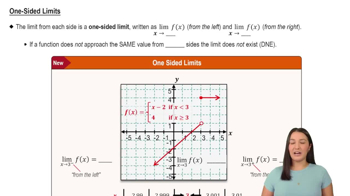
One-Sided Limits

Continuity

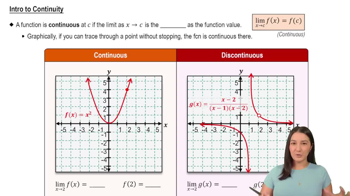
A function is continuous at a point if the limit as x approaches that point equals the function's value at that point. This concept is crucial for determining whether a limit exists. If there is a jump, hole, or asymptote at the point, the limit may not exist, indicating a discontinuity in the function.
Recommended video:
05:34
Intro to Continuity

Existence of Limits

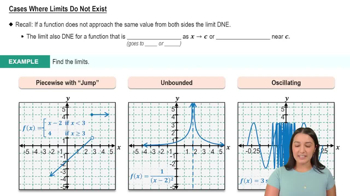
The existence of a limit requires that the left-hand limit and right-hand limit at a point are equal. If they differ, the limit does not exist. Understanding this concept is vital for analyzing the graph of f(x) at x = 1, as it helps identify whether the function approaches a specific value from both sides or if there are discrepancies that prevent a limit from being defined.
Recommended video:
03:07
Cases Where Limits Do Not Exist