Ch. 2 - Limits
Briggs - Calculus: Early Transcendentals 3rd Edition
Briggs3rd EditionCalculus: Early TranscendentalsISBN: 9780136847243Not the one you use?Change textbook
Chapter 2, Problem 3a

Use the graph of hh in the figure to find the following values or state that they do not exist. <IMAGE>
h(2)h\(\left\)(2\(\right\))

Verified step by step guidance
1
Identify the point on the graph where the input value is 2. This means you need to locate the x-coordinate of 2 on the x-axis.
Once you have located x = 2 on the graph, observe the corresponding y-coordinate of the point on the graph. This y-coordinate is the value of h(2).
Check if the graph has a defined point at x = 2. If there is a point, note its y-coordinate. If there is a hole or the graph is not defined at x = 2, then h(2) does not exist.
If the graph is continuous and there is a point at x = 2, then the y-coordinate of this point is the value of h(2).
Conclude by stating the value of h(2) if it exists, or state that it does not exist if the graph is not defined at x = 2.

Verified video answer for a similar problem:

This video solution was recommended by our tutors as helpful for the problem above.
Video duration:
1m
Was this helpful?

Key Concepts

Here are the essential concepts you must grasp in order to answer the question correctly.

Function Evaluation

Function evaluation involves determining the output of a function for a specific input value. In this case, evaluating h(2) means finding the value of the function h when the input is 2. This process typically requires substituting the input into the function's formula or using a graph to identify the corresponding output.
Recommended video:
4:26
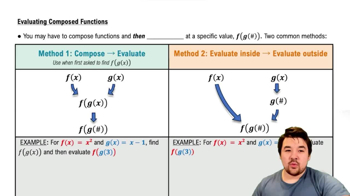
Evaluating Composed Functions

Graph Interpretation

Graph interpretation is the ability to read and analyze graphical representations of functions. It involves understanding the axes, identifying key points, and recognizing the behavior of the function, such as increasing or decreasing trends. This skill is essential for extracting values from a graph, such as the value of h(2) in the given question.
Recommended video:
06:15
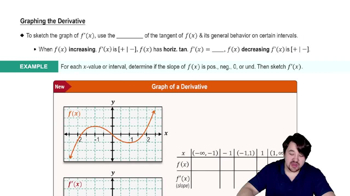
Graphing The Derivative

Existence of Function Values

The existence of function values refers to whether a function produces a valid output for a given input. In some cases, a function may not be defined at certain points, leading to the conclusion that a value does not exist. Understanding this concept is crucial when analyzing graphs, as it helps determine if h(2) can be found or if it is undefined.
Recommended video:
06:37
Average Value of a Function