Ch. 2 - Limits
Briggs - Calculus: Early Transcendentals 3rd Edition
Briggs3rd EditionCalculus: Early TranscendentalsISBN: 9780136847243Not the one you use?Change textbook
Chapter 2, Problem 105

Suppose g(x)=f(1−x) for all x, lim x→1^+ f(x)=4, and lim x→1^− f(x)=6. Find lim x→0^+ g(x) and lim x→0^− g(x).

Verified step by step guidance
1
Step 1: Understand the relationship between g(x) and f(x). We have g(x) = f(1-x). This means that g(x) is essentially f evaluated at 1-x.
Step 2: Determine the behavior of g(x) as x approaches 0 from the right (x → 0^+). As x approaches 0^+, 1-x approaches 1^-. Therefore, lim x→0^+ g(x) = lim x→0^+ f(1-x) = lim x→1^- f(x).
Step 3: Use the given information about f(x). We know that lim x→1^- f(x) = 6. Therefore, lim x→0^+ g(x) = 6.
Step 4: Determine the behavior of g(x) as x approaches 0 from the left (x → 0^-). As x approaches 0^-, 1-x approaches 1^+. Therefore, lim x→0^- g(x) = lim x→0^- f(1-x) = lim x→1^+ f(x).
Step 5: Use the given information about f(x). We know that lim x→1^+ f(x) = 4. Therefore, lim x→0^- g(x) = 4.

Verified video answer for a similar problem:

This video solution was recommended by our tutors as helpful for the problem above.
Video duration:
4m
Was this helpful?

Key Concepts

Here are the essential concepts you must grasp in order to answer the question correctly.

Limits

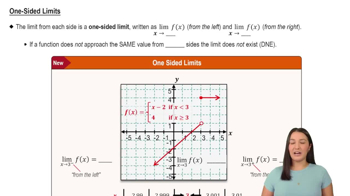
A limit describes the behavior of a function as its input approaches a certain value. In this context, we analyze the limits of the function f(x) as x approaches 1 from the right (1^+) and from the left (1^-). Understanding limits is crucial for determining the values of g(x) at specific points, especially when dealing with piecewise functions or functions defined in terms of others.
Recommended video:
05:50
One-Sided Limits

Function Composition

Function composition involves combining two functions where the output of one function becomes the input of another. Here, g(x) is defined as f(1−x), which means we need to evaluate f at the point (1−x) to find g's limits. This concept is essential for transforming the limits of f into the limits of g, particularly as x approaches 0.
Recommended video:
3:48
Evaluate Composite Functions - Special Cases

One-Sided Limits

One-sided limits refer to the value that a function approaches as the input approaches a specific point from one side only, either from the left (−) or the right (+). In this problem, we need to find the one-sided limits of g(x) as x approaches 0, which requires us to consider how f behaves as its argument approaches 1 from both sides, thus impacting the limits of g.
Recommended video:
05:50
One-Sided Limits