Ch. 2 - Limits
Briggs - Calculus: Early Transcendentals 3rd Edition
Briggs3rd EditionCalculus: Early TranscendentalsISBN: 9780136847243Not the one you use?Change textbook
Chapter 2, Problem 101

Find functions f and g such that lim x→1 f(x)=0 and lim x→1 (f(x)g(x))=5.

Verified step by step guidance
1
Consider the limit condition: \( \lim_{x \to 1} f(x) = 0 \). This implies that as \( x \) approaches 1, \( f(x) \) approaches 0.
To satisfy \( \lim_{x \to 1} (f(x)g(x)) = 5 \), we need \( g(x) \) to behave in such a way that the product \( f(x)g(x) \) approaches 5 as \( x \) approaches 1.
One possible approach is to let \( f(x) = (x-1) \), which clearly satisfies \( \lim_{x \to 1} f(x) = 0 \).
Now, choose \( g(x) = \frac{5}{x-1} \). This choice ensures that the product \( f(x)g(x) = (x-1) \cdot \frac{5}{x-1} = 5 \) for all \( x \neq 1 \).
Verify that \( \lim_{x \to 1} (f(x)g(x)) = \lim_{x \to 1} 5 = 5 \), which satisfies the given condition.

Verified video answer for a similar problem:

This video solution was recommended by our tutors as helpful for the problem above.
Video duration:
7m
Was this helpful?

Key Concepts

Here are the essential concepts you must grasp in order to answer the question correctly.

Limits

A limit is a fundamental concept in calculus that describes the behavior of a function as its input approaches a certain value. In this case, we are interested in the limit of f(x) as x approaches 1, which is given to be 0. Understanding limits is crucial for analyzing the continuity and behavior of functions near specific points.
Recommended video:
05:50
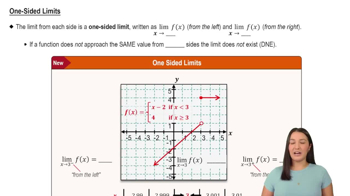
One-Sided Limits

Product of Limits

The product of limits states that if the limits of two functions exist, the limit of their product can be found by multiplying the individual limits. However, if one of the limits is zero, as in lim x→1 f(x) = 0, we must carefully consider the behavior of the second function g(x) to achieve a non-zero limit for their product, specifically lim x→1 (f(x)g(x)) = 5.
Recommended video:
05:18
The Product Rule

Finding Functions

Finding functions that satisfy specific limit conditions often involves creative construction of functions. In this scenario, we need to identify functions f and g such that f approaches 0 while their product approaches 5. This may involve using functions that grow or decay in a controlled manner, such as f(x) = (x-1) and g(x) = 5/(x-1) to meet the limit requirements.
Recommended video:
05:21
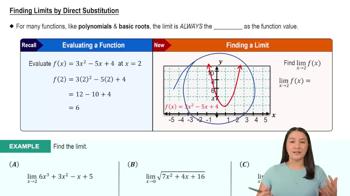
Finding Limits by Direct Substitution