Ch. 2 - Limits
Briggs - Calculus: Early Transcendentals 3rd Edition
Briggs3rd EditionCalculus: Early TranscendentalsISBN: 9780136847243Not the one you use?Change textbook
Chapter 2, Problem 2.4.68a

Given the graph of f in the following figures, find the slope of the secant line that passes through (0,0) and (h,f(h))in terms of h, for h>0 and h<0.


f(x)=x1/3 <IMAGE>

Verified step by step guidance
1
Step 1: Understand the problem. We need to find the slope of the secant line that passes through the points (0,0) and (h,f(h)) on the graph of the function f(x) = x^{1/3}. The slope of a secant line is given by the formula (f(h) - f(0)) / (h - 0).
Step 2: Calculate f(0). Since f(x) = x^{1/3}, we have f(0) = 0^{1/3} = 0.
Step 3: Calculate f(h). For the function f(x) = x^{1/3}, f(h) = h^{1/3}.
Step 4: Substitute f(0) and f(h) into the slope formula. The slope of the secant line is (h^{1/3} - 0) / (h - 0).
Step 5: Simplify the expression. The slope of the secant line is h^{1/3} / h, which can be further simplified to h^{-2/3} for h > 0 and h < 0.

Verified video answer for a similar problem:

This video solution was recommended by our tutors as helpful for the problem above.
Video duration:
2m
Was this helpful?

Key Concepts

Here are the essential concepts you must grasp in order to answer the question correctly.

Secant Line

A secant line is a straight line that intersects a curve at two or more points. In calculus, it is often used to approximate the slope of the curve between those points. The slope of the secant line can be calculated using the formula (f(b) - f(a)) / (b - a), where a and b are the x-coordinates of the points on the curve.
Recommended video:
05:13
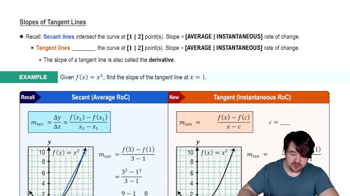
Slopes of Tangent Lines

Slope of a Function

The slope of a function at a given point represents the rate of change of the function's value with respect to changes in its input. For a secant line, the slope is determined by the difference in the function's values at two points divided by the difference in their x-coordinates. This concept is foundational for understanding derivatives, which represent instantaneous rates of change.
Recommended video:
Guided course
3:56
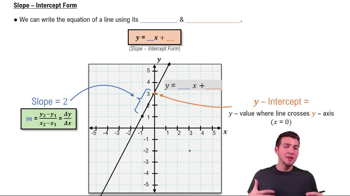
Slope-Intercept Form

Cube Root Function

The cube root function, denoted as f(x) = x^(1/3), is a mathematical function that returns the number whose cube is x. This function is defined for all real numbers and has a characteristic shape, being continuous and increasing. Understanding its behavior, especially near the origin, is crucial for analyzing the secant line's slope as h approaches zero from both positive and negative directions.
Recommended video:
5:57
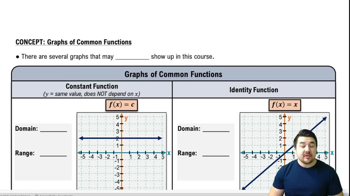
Graphs of Common Functions