a. Estimate lim x→π/4 cos 2x / cos x − sin x by making a table of values of cos 2x / cos x − sin x for values of x approaching π/4. Round your estimate to four digits.

Ch. 2 - Limits
Briggs3rd EditionCalculus: Early TranscendentalsISBN: 9780136847243Not the one you use?Change textbook
Chapter 2, Problem 2.32a
A rock is dropped off the edge of a cliff, and its distance s (in feet) from the top of the cliff after t seconds is s(t)=16t^2. Assume the distance from the top of the cliff to the ground is 96 ft.
a. When will the rock strike the ground?
Verified step by step guidance1

Verified video answer for a similar problem:
This video solution was recommended by our tutors as helpful for the problem above.
Video duration:
2mWas this helpful?
Key Concepts
Here are the essential concepts you must grasp in order to answer the question correctly.
Quadratic Functions
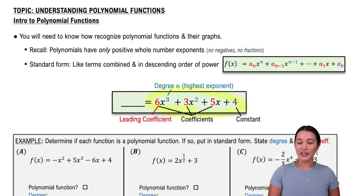
The function s(t) = 16t^2 is a quadratic function, which represents a parabolic relationship between time t and distance s. In this context, it models the distance fallen by the rock over time due to gravity. Understanding the properties of quadratic functions, such as their vertex and roots, is essential for determining when the rock will hit the ground.
Recommended video:
Introduction to Polynomial Functions
Roots of Equations
Finding when the rock strikes the ground involves solving for the roots of the equation s(t) = 16t^2. The roots represent the values of t when the distance s equals zero, indicating the moment the rock reaches the ground. This requires setting the equation equal to the height of the cliff (96 ft) and solving for t.
Recommended video:
Solving Logarithmic Equations
Physical Interpretation of Motion
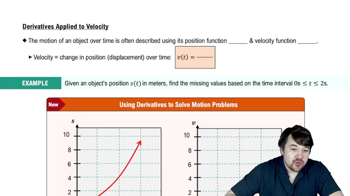
In this scenario, the physical interpretation of motion under gravity is crucial. The equation s(t) = 16t^2 derives from the physics of free fall, where the distance fallen is proportional to the square of the time elapsed. Recognizing this relationship helps in understanding the implications of the calculated time when the rock strikes the ground.
Recommended video:
Derivatives Applied To Velocity
Related Practice
Textbook Question
Textbook Question
For the following position functions, make a table of average velocities similar to those in Exercises 19–20 and make a conjecture about the instantaneous velocity at the indicated time.
a. s(t)=−16t^2+80t+60 at t=3
Textbook Question
A projectile is fired vertically upward and has a position given by s(t)=−16t^2+128t+192, for 0≤t≤9.
a. Graph the position function, for 0≤t≤9.
Textbook Question
Complete the following steps for the given functions.
a. Find the slant asymptote of .
1
views
Textbook Question
a. Use a graphing utility to estimate lim x→0 tan 2x / sin x, lim x→0 tan 3x / sin x, and lim x→0 tan 4x / sin x.
Textbook Question
Given the graph of f in the following figures, find the slope of the secant line that passes through (0,0) and (h,f(h))in terms of h, for h>0 and h<0.
f(x)=x1/3 <IMAGE>
4
views