Ch. 2 - Limits
Briggs - Calculus: Early Transcendentals 3rd Edition
Briggs3rd EditionCalculus: Early TranscendentalsISBN: 9780136847243Not the one you use?Change textbook
Chapter 2, Problem 2.23c

For the following position functions, make a table of average velocities similar to those in Exercises 19–20 and make a conjecture about the instantaneous velocity at the indicated time. 


c. s(t)=40 sin 2t at t=0

Verified step by step guidance
1
Step 1: Understand the problem. We need to find the average velocities of the function \( s(t) = 40 \sin(2t) \) around \( t = 0 \) and make a conjecture about the instantaneous velocity at \( t = 0 \).
Step 2: Recall that the average velocity over an interval \([a, b]\) is given by \( \frac{s(b) - s(a)}{b - a} \). Here, we will calculate this for intervals around \( t = 0 \).
Step 3: Choose intervals around \( t = 0 \), such as \([-0.1, 0.1]\), \([-0.01, 0.01]\), and \([-0.001, 0.001]\). Calculate the average velocity for each interval using the formula from Step 2.
Step 4: Evaluate \( s(t) = 40 \sin(2t) \) at the endpoints of each interval. For example, for the interval \([-0.1, 0.1]\), calculate \( s(0.1) \) and \( s(-0.1) \).
Step 5: Analyze the pattern of the average velocities as the intervals get smaller. Use this pattern to make a conjecture about the instantaneous velocity at \( t = 0 \).

Verified video answer for a similar problem:

This video solution was recommended by our tutors as helpful for the problem above.
Video duration:
11m
Was this helpful?

Key Concepts

Here are the essential concepts you must grasp in order to answer the question correctly.

Average Velocity

Average velocity is defined as the change in position over the change in time. Mathematically, it is calculated as the difference in the position function values at two points divided by the time interval between those points. This concept is crucial for understanding how an object's position changes over time and is foundational for analyzing motion.
Recommended video:
06:29
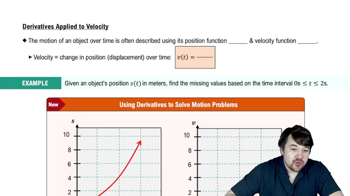
Derivatives Applied To Velocity

Instantaneous Velocity

Instantaneous velocity refers to the velocity of an object at a specific moment in time. It is defined as the limit of the average velocity as the time interval approaches zero. This concept is essential for understanding how an object's speed and direction change at any given instant, and it can be found using the derivative of the position function.
Recommended video:
06:29
Derivatives Applied To Velocity

Trigonometric Functions in Motion

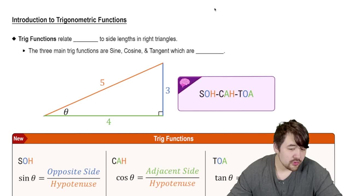
Trigonometric functions, such as sine and cosine, are often used to model periodic motion. In the context of the position function s(t) = 40 sin(2t), the sine function describes how the position varies with time in a wave-like manner. Understanding the properties of these functions, including their amplitude, period, and frequency, is vital for analyzing the motion described by such equations.
Recommended video:
6:04
Introduction to Trigonometric Functions
Related Practice
Textbook Question

Complete the following steps for the given functions. 


c. Graph ff and all of its asymptotes with a graphing utility. Then sketch a graph of the function by hand, correcting any errors appearing in the computer-generated graph.


f(x)=x23x+6f\(\left\)(x\(\right\))=\(\frac{x^2-3}{x+6}\)

Textbook Question

Complete the following steps for the given functions. 


c. Graph f and all of its asymptotes with a graphing utility. Then sketch a graph of the function by hand, correcting any errors appearing in the computer-generated graph.


f(x)=4x3+4x2+7x+4x2+1f\(\left\)(x\(\right\))=\(\frac{4x^3+4x^2+7x+4}{x^2+1}\)

5
views
Textbook Question

Determine whether the following statements are true and give an explanation or counterexample.


c. The graph of a function can have any number of vertical asymptotes but at most two horizontal asymptotes.

Textbook Question

Complete the following steps for the given functions. 


c. Graph f and all of its asymptotes with a graphing utility. Then sketch a graph of the function by hand, correcting any errors appearing in the computer-generated graph.


f(x)=x22x+53x2f\(\left\)(x\(\right\))=\(\frac{x^2-2x+5}{3x-2}\)

4
views
Textbook Question

The graph of ℎ in the figure has vertical asymptotes at x=−2 and x=3. Analyze the following limits. <IMAGE>

lim x→−2 h(x)

Textbook Question

Complete the following steps for the given functions. 


c. Graph f and all of its asymptotes with a graphing utility. Then sketch a graph of the function by hand, correcting any errors appearing in the computer-generated graph.


f(x)=3x22x+53x+4f\(\left\)(x\(\right\))=\(\frac{3x^2-2x+5}{3x+4}\)