Ch. 2 - Limits
Briggs - Calculus: Early Transcendentals 3rd Edition
Briggs3rd EditionCalculus: Early TranscendentalsISBN: 9780136847243Not the one you use?Change textbook
Chapter 2, Problem 43

Find the following limits or state that they do not exist. Assume a, b , c, and k are fixed real numbers.


lim t→5 (1/t^2 − 4t − 5 −1/ 6(t − 5))

Verified step by step guidance
1
Identify the limit expression: \( \lim_{{t \to 5}} \left( \frac{1}{t^2 - 4t - 5} - \frac{1}{6(t - 5)} \right) \).
Factor the quadratic expression in the denominator: \( t^2 - 4t - 5 = (t - 5)(t + 1) \).
Rewrite the limit expression using the factored form: \( \lim_{{t \to 5}} \left( \frac{1}{(t - 5)(t + 1)} - \frac{1}{6(t - 5)} \right) \).
Combine the fractions over a common denominator: \( \frac{1}{(t - 5)(t + 1)} - \frac{1}{6(t - 5)} = \frac{6 - (t + 1)}{6(t - 5)(t + 1)} \).
Simplify the numerator: \( 6 - (t + 1) = 5 - t \), and then evaluate the limit as \( t \to 5 \).

Verified video answer for a similar problem:

This video solution was recommended by our tutors as helpful for the problem above.
Video duration:
5m
Was this helpful?

Key Concepts

Here are the essential concepts you must grasp in order to answer the question correctly.

Limits

A limit is a fundamental concept in calculus that describes the behavior of a function as its input approaches a certain value. It helps in understanding how functions behave near points of interest, including points where they may not be defined. In this question, we are tasked with finding the limit of a function as t approaches 5, which requires evaluating the function's behavior close to that point.
Recommended video:
05:50
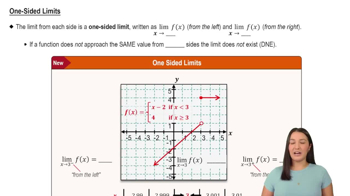
One-Sided Limits

Indeterminate Forms

Indeterminate forms occur in calculus when direct substitution into a limit results in expressions like 0/0 or ∞/∞. These forms require further analysis, often using algebraic manipulation or L'Hôpital's Rule, to resolve the limit. In the given question, substituting t = 5 directly into the expression leads to an indeterminate form, necessitating additional steps to find the limit.
Recommended video:
Guided course
3:56
Slope-Intercept Form

L'Hôpital's Rule

L'Hôpital's Rule is a method used to evaluate limits of indeterminate forms by differentiating the numerator and denominator. If a limit results in 0/0 or ∞/∞, applying this rule can simplify the expression and help find the limit. In this case, if the limit leads to an indeterminate form, L'Hôpital's Rule may be a suitable approach to determine the limit as t approaches 5.
Recommended video: