Ch. 2 - Limits
Briggs - Calculus: Early Transcendentals 3rd Edition
Briggs3rd EditionCalculus: Early TranscendentalsISBN: 9780136847243Not the one you use?Change textbook
Chapter 2, Problem 40

Complete the following steps for each function.


c. State the interval(s) of continuity.


f(x)={x^3+4x+1 if x≤0
2x^3 if x>0; a=0

Verified step by step guidance
1
Step 1: Understand the piecewise function. The function f(x) is defined as f(x) = x^3 + 4x + 1 for x \(\leq\) 0 and f(x) = 2x^3 for x > 0.
Step 2: Determine the continuity at the point where the function changes, which is at x = 0.
Step 3: Check the left-hand limit as x approaches 0 from the left (x \(\to\) 0^-). Calculate \(\lim\)_{x \(\to\) 0^-} (x^3 + 4x + 1).
Step 4: Check the right-hand limit as x approaches 0 from the right (x \(\to\) 0^+). Calculate \(\lim\)_{x \(\to\) 0^+} (2x^3).
Step 5: Compare the left-hand limit, right-hand limit, and the value of the function at x = 0 to determine if the function is continuous at x = 0. If all are equal, the function is continuous at x = 0. Otherwise, it is not.

Verified video answer for a similar problem:

This video solution was recommended by our tutors as helpful for the problem above.
Video duration:
4m
Was this helpful?

Key Concepts

Here are the essential concepts you must grasp in order to answer the question correctly.

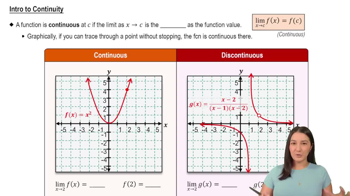
Continuity of Functions

A function is continuous at a point if the limit of the function as it approaches that point equals the function's value at that point. For a function to be continuous over an interval, it must be continuous at every point within that interval. This concept is crucial for determining where a function does not have breaks, jumps, or asymptotes.
Recommended video:
05:34
Intro to Continuity

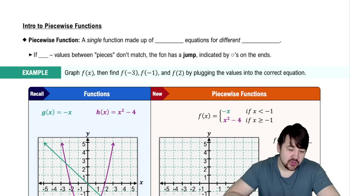
Piecewise Functions

Piecewise functions are defined by different expressions based on the input value. In this case, the function f(x) has two distinct expressions depending on whether x is less than or equal to zero or greater than zero. Understanding how to analyze each piece separately is essential for determining the overall continuity of the function.
Recommended video:
05:36
Piecewise Functions

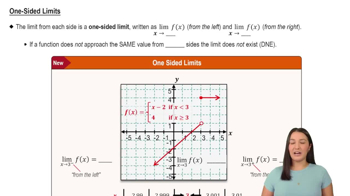
Limits

Limits are fundamental in calculus for understanding the behavior of functions as they approach specific points. To assess continuity at the boundary point (x=0) of the piecewise function, one must evaluate the left-hand limit and the right-hand limit. If both limits exist and are equal to the function's value at that point, the function is continuous there.
Recommended video:
05:50
One-Sided Limits