Ch. 2 - Limits
Briggs - Calculus: Early Transcendentals 3rd Edition
Briggs3rd EditionCalculus: Early TranscendentalsISBN: 9780136847243Not the one you use?Change textbook
Chapter 2, Problem 73a

Analyze lim x→∞ f(x) and lim x→−∞ f(x), and then identify any horizontal asymptotes.
f(x) = (3x4 + 3x3 − 36x2) / (x4 − 25x2 + 144)

Verified step by step guidance
1
Step 1: Identify the degrees of the numerator and the denominator. The numerator is 3x^4 + 3x^3 - 36x^2, which is a polynomial of degree 4. The denominator is x^4 - 25x^2 + 144, also a polynomial of degree 4.
Step 2: Since the degrees of the numerator and the denominator are equal, the horizontal asymptote is determined by the ratio of the leading coefficients. The leading coefficient of the numerator is 3, and the leading coefficient of the denominator is 1.
Step 3: Calculate the horizontal asymptote by dividing the leading coefficients: y = 3/1 = 3. Therefore, the horizontal asymptote is y = 3.
Step 4: Analyze lim x→∞ f(x). As x approaches infinity, the terms with the highest degree in both the numerator and the denominator dominate, so lim x→∞ f(x) = 3.
Step 5: Analyze lim x→−∞ f(x). Similarly, as x approaches negative infinity, the terms with the highest degree dominate, so lim x→−∞ f(x) = 3.

Verified video answer for a similar problem:

This video solution was recommended by our tutors as helpful for the problem above.
Video duration:
3m
Was this helpful?

Key Concepts

Here are the essential concepts you must grasp in order to answer the question correctly.

Limits at Infinity

Limits at infinity involve evaluating the behavior of a function as the input approaches positive or negative infinity. This analysis helps determine how the function behaves for very large or very small values of x, which is crucial for identifying horizontal asymptotes. In this context, we assess the leading terms of the polynomial in the numerator and denominator to simplify the limit.
Recommended video:
05:50
One-Sided Limits

Horizontal Asymptotes

Horizontal asymptotes describe the behavior of a function as it approaches a specific value (y = c) when x approaches infinity or negative infinity. They indicate the value that the function approaches but does not necessarily reach. To find horizontal asymptotes, we compare the degrees of the polynomials in the numerator and denominator after evaluating the limits at infinity.
Recommended video:
5:46
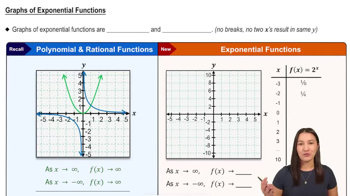
Graphs of Exponential Functions

Polynomial Functions

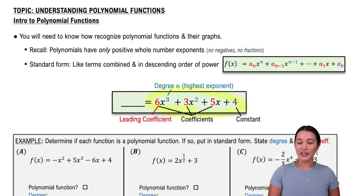
Polynomial functions are expressions involving variables raised to whole number powers, combined using addition, subtraction, and multiplication. The degree of a polynomial, determined by the highest power of x, plays a critical role in limit analysis. In the given function, understanding the degrees of the polynomials in both the numerator and denominator is essential for evaluating limits and identifying horizontal asymptotes.
Recommended video:
6:04
Introduction to Polynomial Functions