
Textbook Question
Determine whether the following statements are true and give an explanation or counterexample. Assume a and L are finite numbers.
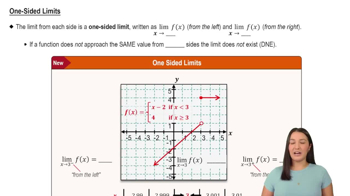
If limx→a f(x) = L, then f(a)=L.
3
views

 Verified step by step guidance
 05:50
05:50
 5:46
5:46 6:04
6:04Determine whether the following statements are true and give an explanation or counterexample. Assume a and L are finite numbers.
If limx→a f(x) = L, then f(a)=L.
Analyze lim x→∞ f(x) and lim x→−∞ f(x), and then identify any horizontal asymptotes.
f(x) = (3x4 + 3x3 − 36x2) / (x4 − 25x2 + 144)
Determine whether the following statements are true and give an explanation or counterexample. Assume a and L are finite numbers.
The limit lim x→a f(x) / g(x) does not exist if g(a)=0.
Let f(x) = {x^2+1 / if x<−1
√x+1 if x≥−1.
Compute the following limits or state that they do not exist.
limx→−1 f(x)
Find the vertical asymptotes. For each vertical asymptote x=a, analyze lim x→a- f(x) and lim x→a+ f(x).
f(x) = (2x3 + 10x2 + 12x) / (x3 + 2x2)
Find the vertical asymptotes. For each vertical asymptote x = a, analyze lim x→a- f(x) and lim x→a+ f(x).
f(x) = (3x4 + 3x3 − 36x2) / (x4 − 25x2 + 144)