
Ch. 11 - Power Series
Briggs - Calculus: Early Transcendentals 3rd Edition
Briggs3rd EditionCalculus: Early TranscendentalsISBN: 9780136847243Not the one you use?Change textbook
Chapter 11, Problem 11.3.61

Working with binomial series Use properties of power series, substitution, and factoring to find the first four nonzero terms of the Maclaurin series for the following functions. Use the Maclaurin series


(1 + x)⁻² = 1 − 2x + 3x² − 4x³ + ⋯, for −1 < x < 1.


1/(3 + 4x)²

Verified step by step guidance
1
Start with the given Maclaurin series for \((1 + x)^{-2}\): \[ (1 + x)^{-2} = 1 - 2x + 3x^{2} - 4x^{3} + \cdots \]
Rewrite the function \(\frac{1}{(3 + 4x)^2}\) in a form that resembles \((1 + u)^{-2}\). Factor out the constant from the denominator: \[ \frac{1}{(3 + 4x)^2} = \frac{1}{9(1 + \frac{4x}{3})^2} \]
Identify the substitution \(u = \frac{4x}{3}\) so that the function becomes: \[ \frac{1}{9} (1 + u)^{-2} \]
Use the known Maclaurin series for \((1 + u)^{-2}\) and substitute \(u = \frac{4x}{3}\) into the series: \[ (1 + u)^{-2} = 1 - 2u + 3u^{2} - 4u^{3} + \cdots \]
Multiply the entire series by \(\frac{1}{9}\) and expand the terms up to the \(x^{3}\) term to find the first four nonzero terms of the Maclaurin series for \(\frac{1}{(3 + 4x)^2}\).

Verified video answer for a similar problem:

This video solution was recommended by our tutors as helpful for the problem above.
Video duration:
6m
Was this helpful?

Key Concepts

Here are the essential concepts you must grasp in order to answer the question correctly.

Maclaurin Series

A Maclaurin series is a special case of the Taylor series expanded at x = 0. It represents a function as an infinite sum of terms involving powers of x and derivatives evaluated at zero. Understanding this allows approximation of functions near zero using polynomials.
Recommended video:
08:26
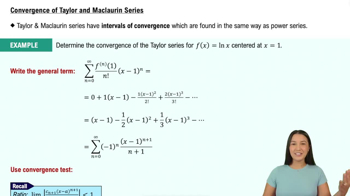
Convergence of Taylor & Maclaurin Series

Power Series Substitution and Manipulation

Power series substitution involves replacing the variable in a known series with an expression to find a new series expansion. Factoring and algebraic manipulation help rewrite functions into forms compatible with known series, enabling term-by-term expansion.
Recommended video:
05:58
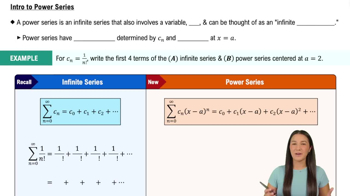
Intro to Power Series

Binomial Series Expansion

The binomial series generalizes the expansion of expressions like (1 + x)^n for any real exponent n. It provides coefficients for each term in the series, which is essential for expanding functions like (1 + x)^{-2} and related forms within their radius of convergence.
Recommended video:
06:00
Geometric Series