
Textbook Question
Evaluating an infinite series Write the Maclaurin series for f(x) = ln (1+x) and find the interval of convergence. Evaluate f(−1/2) to find the value of ∑ₖ₌₁∞ 1/(k 2ᵏ)

 Verified step by step guidance
 05:53
05:53
 05:14
05:14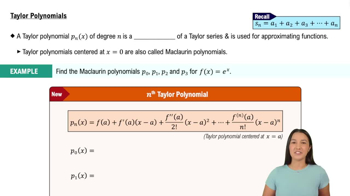 07:00
07:00Evaluating an infinite series Write the Maclaurin series for f(x) = ln (1+x) and find the interval of convergence. Evaluate f(−1/2) to find the value of ∑ₖ₌₁∞ 1/(k 2ᵏ)
Working with binomial series Use properties of power series, substitution, and factoring to find the first four nonzero terms of the Maclaurin series for the following functions. Use the Maclaurin series
(1 + x)⁻² = 1 − 2x + 3x² − 4x³ + ⋯, for −1 < x < 1.
1/(3 + 4x)²
Radius and interval of convergence Determine the radius and interval of convergence of the following power series.
∑ₖ₌₁∞ ((−1)ᵏ⁺¹(x−1)ᵏ)/k
Approximating real numbers Use an appropriate Taylor series to find the first four nonzero terms of an infinite series that is equal to the following numbers.
tan ⁻¹ (1/2)
Power series for derivatives
a. Differentiate the Taylor series centered at 0 for the following functions.
b. Identify the function represented by the differentiated series.
c. Give the interval of convergence of the power series for the derivative.
f(x) = ln (1 + x)
Approximating definite integrals Use a Taylor series to approximate the following definite integrals. Retain as many terms as needed to ensure the error is less than 10⁻⁴.∫₀⁰ᐧ²⁵ e⁻ˣ² dx