
Ch. 11 - Power Series
Briggs - Calculus: Early Transcendentals 3rd Edition
Briggs3rd EditionCalculus: Early TranscendentalsISBN: 9780136847243Not the one you use?Change textbook
Chapter 11, Problem 11.4.4

Use the Taylor series for cos x centered at 0 to verify that lim ₓ→ₐ (1− cos x)/x = 0.

Verified step by step guidance
1
Recall the Taylor series expansion of \( \cos x \) centered at 0, which is given by: \[ \cos x = 1 - \frac{x^{2}}{2!} + \frac{x^{4}}{4!} - \frac{x^{6}}{6!} + \cdots \]
Substitute the Taylor series expansion of \( \cos x \) into the expression \( \frac{1 - \cos x}{x} \): \[ \frac{1 - \cos x}{x} = \frac{1 - \left(1 - \frac{x^{2}}{2!} + \frac{x^{4}}{4!} - \cdots \right)}{x} \]
Simplify the numerator by distributing the negative sign and combining like terms: \[ 1 - 1 + \frac{x^{2}}{2!} - \frac{x^{4}}{4!} + \cdots = \frac{x^{2}}{2!} - \frac{x^{4}}{4!} + \cdots \]
Rewrite the expression as: \[ \frac{\frac{x^{2}}{2!} - \frac{x^{4}}{4!} + \cdots}{x} = \frac{x^{2}}{2! \cdot x} - \frac{x^{4}}{4! \cdot x} + \cdots = \frac{x}{2!} - \frac{x^{3}}{4!} + \cdots \]
Now, analyze the limit as \( x \to 0 \): each term contains a factor of \( x \) or higher powers of \( x \), so all terms approach 0. Therefore, \[ \lim_{x \to 0} \frac{1 - \cos x}{x} = 0 \]

Verified video answer for a similar problem:

This video solution was recommended by our tutors as helpful for the problem above.
Video duration:
3m
Was this helpful?

Key Concepts

Here are the essential concepts you must grasp in order to answer the question correctly.

Taylor Series Expansion

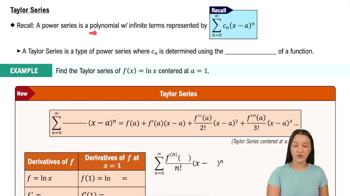
The Taylor series expresses a function as an infinite sum of terms calculated from its derivatives at a single point. For cos x centered at 0, it expands as 1 - x²/2! + x⁴/4! - ..., which approximates cos x near zero and helps analyze limits involving cos x.
Recommended video:
08:42
Taylor Series

Limit of a Function as x Approaches a Point

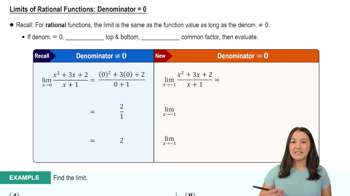
A limit describes the value a function approaches as the input approaches a specific point. Evaluating limₓ→0 (1 - cos x)/x involves understanding how the numerator and denominator behave near zero to determine the limit's value.
Recommended video:
06:11
Limits of Rational Functions: Denominator = 0

Behavior of Higher-Order Terms in Limits

When using series expansions in limits, higher-order terms (like x⁴ and beyond) become negligible as x approaches zero. Recognizing which terms dominate allows simplification of expressions to find the limit accurately.
Recommended video:
02:42
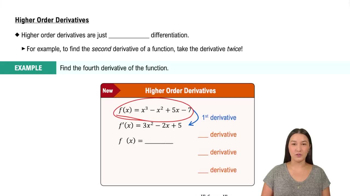
Higher Order Derivatives
Related Practice
Textbook Question

Use of Tech Linear and quadratic approximation


a. Find the linear approximating polynomial for the following functions centered at the given point a.


b. Find the quadratic approximating polynomial for the following functions centered at a.


c Use the polynomials obtained in parts (a) and (b) to approximate the given quantity.


Find the Taylor polynomials p₁, …, p₅ centered at a=0 for f(x)=e⁻ˣ

Textbook Question

{Use of Tech} Approximations with Taylor polynomials


a. Approximate the given quantities using Taylor polynomials with n = 3.


b. Compute the absolute error in the approximation, assuming the exact value is given by a calculator.


e⁰ᐧ¹²

Textbook Question

Radius and interval of convergence Determine the radius and interval of convergence of the following power series.


∑ₖ₌₀∞ (x/3)ᵏ

1
views
Textbook Question

{Use of Tech} Approximations with Taylor polynomials


a. Approximate the given quantities using Taylor polynomials with n = 3.


b. Compute the absolute error in the approximation, assuming the exact value is given by a calculator.


√1.06

Textbook Question

Evaluating an infinite series Let f(x) = (eˣ − 1)/x, for x ≠ 0, and f(0)=1. Use the Taylor series for f centered at 0 to evaluate f(1) and to find the value of ∑ₖ₌₀∞ 1/(k+1)!

Textbook Question

{Use of Tech} Approximating sin x Let f(x)=sin x, and let pₙ and qₙ be nth−order Taylor polynomials for f centered at 0 and π, respectively.

a. Find p₅ and q₅

b. Graph f, p₅, and q₅ on the interval [−π, 2π]. On what interval is p₅ a better approximation to f than q₅? On what interval is q₅ a better approximation to f than p₅?

c. Complete the following table showing the errors in the approximations given by p₅ and q₅ at selected points.

d. At which points in the table is p₅ a better approximation to f than q₅? At which points do p₅ and q₅ give equal approximations to f? Explain your observations.

1
views