Suppose the power series ∑ₖ₌₀∞ cₖ(x−a)ᵏ has an interval of convergence of (−3,7]. Find the center a and the radius of convergence R.
Ch. 11 - Power Series
Briggs3rd EditionCalculus: Early TranscendentalsISBN: 9780136847243Not the one you use?Change textbook
Chapter 11, Problem 11.1.53
{Use of Tech} Maximum error Use the remainder term to find a bound on the error in the following approximations on the given interval. Error bounds are not unique.
sin x ≈ x − x³/6 on [π/4, π/4]
Verified step by step guidance1
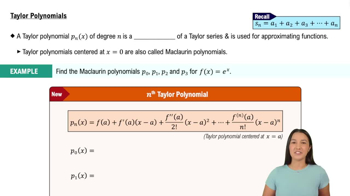
Identify the Taylor polynomial used for the approximation. Here, \( \sin x \) is approximated by \( x - \frac{x^3}{6} \), which is the Taylor polynomial of degree 3 centered at 0 (Maclaurin polynomial).
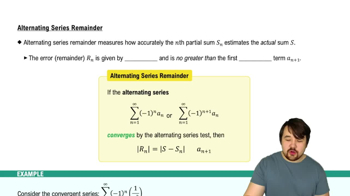
Recall the remainder term (Lagrange form) for the Taylor polynomial of degree 3: \( R_3(x) = \frac{f^{(4)}(c)}{4!} x^4 \), where \( c \) is some value between 0 and \( x \).
Determine the fourth derivative of \( \sin x \). Since \( f(x) = \sin x \), the derivatives cycle every four steps: \( f^{(4)}(x) = \sin x \).
Find the maximum value of \( |f^{(4)}(c)| = |\sin c| \) on the interval \( [\frac{\pi}{4}, \frac{\pi}{4}] \). Since the interval is a single point, \( c = \frac{\pi}{4} \), so evaluate \( |\sin(\frac{\pi}{4})| \).
Use the remainder formula to write the error bound: \( |R_3(x)| \leq \frac{|\sin c|}{4!} |x|^4 \). Substitute the values for \( c \) and \( x \) from the interval to get the bound on the error.

Verified video answer for a similar problem:
This video solution was recommended by our tutors as helpful for the problem above.
Video duration:
5mWas this helpful?
Key Concepts
Here are the essential concepts you must grasp in order to answer the question correctly.
Taylor Polynomial Approximation
A Taylor polynomial approximates a function near a point using derivatives at that point. For sin x, the polynomial x − x³/6 is the third-degree Taylor polynomial centered at 0, providing an approximation of sin x near 0 by matching its value and derivatives up to the third order.
Recommended video:
Taylor Polynomials
Remainder Term (Lagrange Form)
The remainder term quantifies the error between the actual function and its Taylor polynomial approximation. The Lagrange form expresses this error as a function of the next derivative evaluated at some point in the interval, allowing us to bound the maximum error on the given interval.
Recommended video:
Alternating Series Remainder
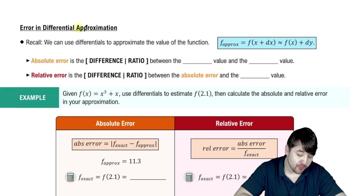
Error Bound on a Closed Interval
To find an error bound on [π/4, π/4], we evaluate the maximum absolute value of the relevant derivative in the remainder term over the interval. This maximum value, combined with the formula for the remainder, gives a guaranteed upper bound on the approximation error.
Recommended video:
Determining Error and Relative Error
Related Practice
Textbook Question
1
views
Textbook Question
Combining power series Use the power series representation
f(x ) =ln (1 − x) = −∑ₖ₌₁∞ xᵏ/k, for −1 ≤ x < 1,
to find the power series for the following functions (centered at 0). Give the interval of convergence of the new series.
f(3x) = ln (1 − 3x)
Textbook Question
Differential equations
a. Find a power series for the solution of the following differential equations, subject to the given initial condition
b. Identify the function represented by the power series.
y′(t) − 3y = 10, y(0) = 2
Textbook Question
The first three Taylor polynomials for f(x)=√(1+x) centered at 0 are p₀ = 1, p₁ = 1+x/2, and p₂ = 1 + x/2 − x²/8. Find three approximations to √1.1.
1
views
Textbook Question
Radius and interval of convergence Determine the radius and interval of convergence of the following power series.
∑ₖ₌₁∞ (xᵏ/kᵏ)