Ch. 11 - Power Series
Briggs - Calculus: Early Transcendentals 3rd Edition
Briggs3rd EditionCalculus: Early TranscendentalsISBN: 9780136847243Not the one you use?Change textbook
Chapter 11, Problem 11.4.35

Differential equations


a. Find a power series for the solution of the following differential equations, subject to the given initial condition
b. Identify the function represented by the power series.


y′(t) − 3y = 10, y(0) = 2

Verified step by step guidance
1
Rewrite the differential equation in a standard form: \(y'(t) = 3y + 10\).
Assume the solution \(y(t)\) can be expressed as a power series centered at \(t=0\): \(y(t) = \sum_{n=0}^{\infty} a_n t^n\).
Differentiate the power series term-by-term to find \(y'(t) = \sum_{n=1}^{\infty} n a_n t^{n-1}\).
Substitute the series expressions for \(y(t)\) and \(y'(t)\) into the differential equation, and equate coefficients of like powers of \(t\) to form a recurrence relation for the coefficients \(a_n\).
Use the initial condition \(y(0) = 2\) to find \(a_0\), then use the recurrence relation to find subsequent coefficients \(a_n\), thus obtaining the power series solution. Finally, recognize the power series as a known function by comparing it to standard series expansions.

Verified video answer for a similar problem:

This video solution was recommended by our tutors as helpful for the problem above.
Video duration:
10m
Was this helpful?

Key Concepts

Here are the essential concepts you must grasp in order to answer the question correctly.

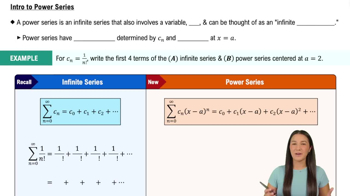
Power Series Solutions to Differential Equations

A power series solution expresses the solution of a differential equation as an infinite sum of powers of the independent variable. This method is useful when solutions cannot be found using elementary functions. It involves assuming a solution in the form of a series and determining coefficients by substituting into the differential equation.
Recommended video:
05:58
Intro to Power Series

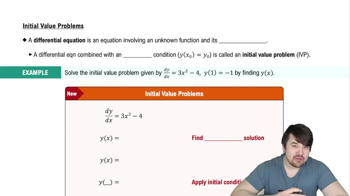
Initial Conditions and Their Role

Initial conditions specify the value of the solution and possibly its derivatives at a particular point, allowing for the determination of unknown constants in the general solution. For power series, initial conditions help find the first coefficient(s) and ensure the solution matches the problem's requirements.
Recommended video:
05:03
Initial Value Problems

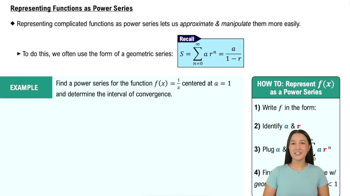
Identifying Functions from Power Series

Once a power series solution is found, it can often be recognized as a known function by comparing it to standard series expansions (e.g., exponential, trigonometric). This identification simplifies understanding the solution's behavior and provides a closed-form expression.
Recommended video:
07:32
Representing Functions as Power Series