Ch. 11 - Power Series
Briggs - Calculus: Early Transcendentals 3rd Edition
Briggs3rd EditionCalculus: Early TranscendentalsISBN: 9780136847243Not the one you use?Change textbook
Chapter 11, Problem 11.1.80

{Use of Tech} Best center point Suppose you wish to approximate cos (π/ 2) using Taylor polynomials. Is the approximation more accurate if you use Taylor polynomials centered at 0 or at π/6? Use a calculator for numerical experiments and check for consistency with Theorem 11.2. Does the answer depend on the order of the polynomial?

Verified step by step guidance
1
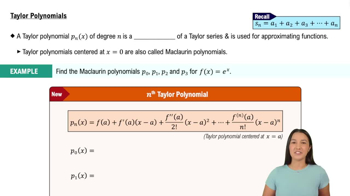
Recall that the Taylor polynomial of a function \(f(x)\) centered at a point \(a\) is given by the formula: \[f(x) \approx \sum_{n=0}^N \frac{f^{(n)}(a)}{n!} (x - a)^n,\] where \(f^{(n)}(a)\) is the \(n\)th derivative of \(f\) evaluated at \(a\), and \(N\) is the order of the polynomial.
Identify the function and points involved: here, \(f(x) = \cos x\), and we want to approximate \(\cos(\pi/2)\). The two centers to compare are \(a=0\) and \(a=\pi/6\).
Understand that the accuracy of the Taylor polynomial depends on how close the point of approximation \(x=\pi/2\) is to the center \(a\). The error term (remainder) in Taylor's theorem involves \((x - a)^{N+1}\), so smaller \(|x - a|\) generally leads to better accuracy for the same order \(N\).
Perform numerical experiments using a calculator or software: compute Taylor polynomials of various orders \(N\) centered at \(0\) and at \(\pi/6\), then evaluate them at \(x=\pi/2\). Compare the absolute errors \(|\cos(\pi/2) - P_N(\pi/2)|\) for each center and order.
Analyze whether the difference in accuracy depends on the order \(N\). According to Theorem 11.2 (Taylor's theorem with remainder), the error decreases as \(N\) increases, but the center closer to \(\pi/2\) (which is \(\pi/6\)) should generally give a more accurate approximation for lower orders. For very high orders, both centers may yield similar accuracy.

Verified video answer for a similar problem:

This video solution was recommended by our tutors as helpful for the problem above.
Video duration:
2m
Was this helpful?

Key Concepts

Here are the essential concepts you must grasp in order to answer the question correctly.

Taylor Polynomials and Centering Point

A Taylor polynomial approximates a function near a specific point called the center. The accuracy of the approximation depends on how close the evaluation point is to this center. Choosing a center closer to the point of interest generally yields a better approximation because the polynomial matches the function and its derivatives at that center.
Recommended video:
07:00
Taylor Polynomials

Remainder Term and Error Bound (Theorem 11.2)

Theorem 11.2 provides an error bound for Taylor polynomial approximations using the remainder term. It states that the error depends on the distance between the evaluation point and the center, and on the size of higher-order derivatives. This theorem helps predict how the approximation error changes with different centers and polynomial orders.
Recommended video:
05:22
Fundamental Theorem of Calculus Part 2

Effect of Polynomial Order on Approximation Accuracy

Increasing the order of a Taylor polynomial generally improves the approximation by including more terms of the function's derivative information. However, the improvement also depends on the choice of center; a higher-order polynomial centered far from the evaluation point may still be less accurate than a lower-order polynomial centered closer. Thus, both order and center influence accuracy.
Recommended video:
08:42
Taylor Series