
Textbook Question
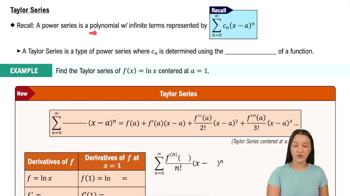
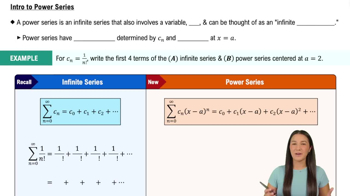
Manipulating Taylor series Use the Taylor series in Table 11.5 to find the first four nonzero terms of the Taylor series for the following functions centered at 0.
(1 + x⁴)⁻¹

 Verified step by step guidance
 08:42
08:42
 05:58
05:58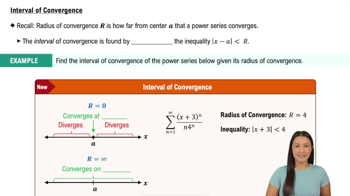 08:44
08:44Manipulating Taylor series Use the Taylor series in Table 11.5 to find the first four nonzero terms of the Taylor series for the following functions centered at 0.
(1 + x⁴)⁻¹
Functions to power series Find power series representations centered at 0 for the following functions using known power series. Give the interval of convergence for the resulting series.
f(x) = ln √(4 − x²)
Shifting power series If the power series f(x)=∑ cₖ xᵏ has an interval of convergence of |x|<R, what is the interval of convergence of the power series for f(x−a), where a ≠ 0 is a real number?
{Use of Tech} Best center point Suppose you wish to approximate cos (π/ 2) using Taylor polynomials. Is the approximation more accurate if you use Taylor polynomials centered at 0 or at π/6? Use a calculator for numerical experiments and check for consistency with Theorem 11.2. Does the answer depend on the order of the polynomial?
Radius and interval of convergence Determine the radius and interval of convergence of the following power series.
∑ₖ₌₁∞ (kx)ᵏ
Suppose f(0)=1, f'(0)=0, f''(0)=2, and f⁽³⁾(0)=6. Find the third-order Taylor polynomial for f centered at 0 and use it to approximate f(0.2).