Ch. 11 - Power Series
Briggs - Calculus: Early Transcendentals 3rd Edition
Briggs3rd EditionCalculus: Early TranscendentalsISBN: 9780136847243Not the one you use?Change textbook
Chapter 11, Problem 11.3.25c

Taylor series and interval of convergence


c. Determine the interval of convergence of the series.


f(x) = ln (x − 2), a = 3

Verified step by step guidance
1
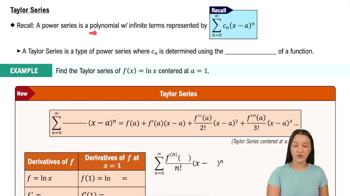
Start by writing the Taylor series expansion of the function \(f(x) = \ln(x - 2)\) centered at \(a = 3\). Recall that the Taylor series of \(f(x)\) about \(a\) is given by \(\displaystyle \sum_{n=0}^{\infty} \frac{f^{(n)}(a)}{n!} (x - a)^n\).
Find the derivatives of \(f(x) = \ln(x - 2)\) evaluated at \(x = 3\). Note that \(f(x)\) can be rewritten as \(\ln(u)\) where \(u = x - 2\), so \(f(x) = \ln(u)\) and \(u\) is shifted by 1 at \(x=3\) since \(u = 3 - 2 = 1\).
Express the general term of the Taylor series using the \(n\)-th derivative of \(f\) at \(a=3\). For \(f(x) = \ln(x-2)\), the \(n\)-th derivative has a known pattern involving factorials and powers of \((x-2)\), which you can use to write the general term \(c_n (x-3)^n\).
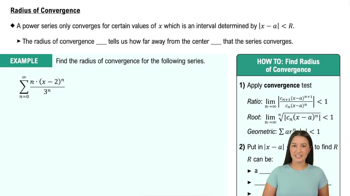
Determine the radius of convergence \(R\) of the Taylor series by applying the Ratio Test or Root Test to the general term of the series. This involves taking the limit as \(n \to \infty\) of the ratio of consecutive terms or the \(n\)-th root of the absolute value of the \(n\)-th term.
Once you find the radius of convergence \(R\), write the interval of convergence as \((a - R, a + R)\), i.e., \((3 - R, 3 + R)\). Then check the endpoints \(x = 3 - R\) and \(x = 3 + R\) by substituting back into the original series to see if the series converges or diverges at these points, thus determining the full interval of convergence.

Verified video answer for a similar problem:

This video solution was recommended by our tutors as helpful for the problem above.
Video duration:
4m
Was this helpful?

Key Concepts

Here are the essential concepts you must grasp in order to answer the question correctly.

Taylor Series Expansion

A Taylor series represents a function as an infinite sum of terms calculated from the derivatives at a single point a. For f(x) = ln(x - 2) centered at a = 3, the series approximates the function near x = 3 using derivatives evaluated at that point.
Recommended video:
08:42
Taylor Series

Radius and Interval of Convergence

The radius of convergence is the distance from the center a within which the Taylor series converges to the function. The interval of convergence is the actual range of x-values where the series converges, determined by testing endpoints after finding the radius.
Recommended video:
07:36
Radius of Convergence

Domain Restrictions and Singularities

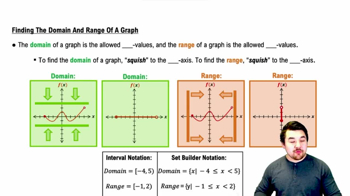
The function ln(x - 2) is defined only for x > 2, so the series cannot converge outside this domain. The singularity at x = 2 limits the radius of convergence, as the series cannot converge beyond the nearest point where the function is undefined.
Recommended video:
5:10
Finding the Domain and Range of a Graph