Ch. 11 - Power Series
Briggs - Calculus: Early Transcendentals 3rd Edition
Briggs3rd EditionCalculus: Early TranscendentalsISBN: 9780136847243Not the one you use?Change textbook
Chapter 11, Problem 11.4.65c

Explain why or why not Determine whether the following statements are true and give an explanation or counterexample.


c. ∑ₖ₌₀∞ (ln 2)ᵏ/k! = 2

Verified step by step guidance
1
Recognize that the series given is an infinite sum of the form \(\sum_{k=0}^\infty \frac{(\ln 2)^k}{k!}\), which resembles the Taylor series expansion of the exponential function \(e^x = \sum_{k=0}^\infty \frac{x^k}{k!}\).
Identify that in this series, \(x = \ln 2\), so the sum can be rewritten as \(\sum_{k=0}^\infty \frac{(\ln 2)^k}{k!} = e^{\ln 2}\).
Recall the property of exponentials and logarithms that \(e^{\ln a} = a\) for any positive \(a\), so \(e^{\ln 2} = 2\).
Conclude that the series converges to 2, which means the statement \(\sum_{k=0}^\infty \frac{(\ln 2)^k}{k!} = 2\) is true.
Therefore, the explanation is that the series is the exponential series evaluated at \(\ln 2\), and by the fundamental properties of logarithms and exponentials, the sum equals 2.

Verified video answer for a similar problem:

This video solution was recommended by our tutors as helpful for the problem above.
Video duration:
2m
Was this helpful?

Key Concepts

Here are the essential concepts you must grasp in order to answer the question correctly.

Infinite Series and Convergence

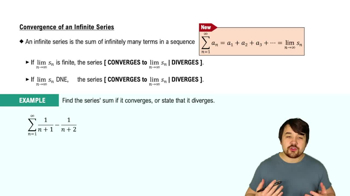
An infinite series is the sum of infinitely many terms. Understanding whether such a series converges (approaches a finite limit) or diverges is crucial. Convergence tests and recognizing known series forms help determine the sum or behavior of the series.
Recommended video:
06:52
Convergence of an Infinite Series

Exponential Series Expansion

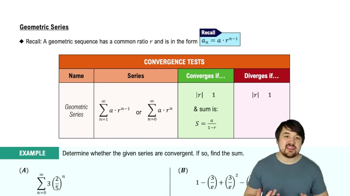
The exponential function e^x can be expressed as the infinite series ∑ₖ₌₀∞ xᵏ/k!. This power series converges for all real x and provides a way to evaluate sums involving factorial denominators and powers, linking series to exponential functions.
Recommended video:
06:00
Geometric Series

Properties of the Natural Logarithm

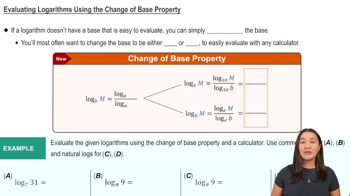
The natural logarithm ln(x) is the inverse of the exponential function e^x. Knowing that e^(ln a) = a allows substitution in series expressions, which helps simplify and evaluate series involving powers of ln(2) by relating them to powers of e.
Recommended video:
05:36
Change of Base Property