Explain why the magnitude of the remainder in an alternating series (with terms that are nonincreasing in magnitude) is less than or equal to the magnitude of the first neglected term.

Ch. 10 - Sequences and Infinite Series
Briggs3rd EditionCalculus: Early TranscendentalsISBN: 9780136847243Not the one you use?Change textbook
Chapter 10, Problem 10.3.97
Property of divergent series Prove Property 2 of Theorem 10.8: If ∑ aₖ diverges, then ∑ caₖ also diverges, for any real number c ≠ 0.
Verified step by step guidance1
Recall the statement of Property 2 of Theorem 10.8: If the series \(\sum a_k\) diverges, then for any real number \(c \neq 0\), the series \(\sum c a_k\) also diverges.
Start by assuming that \(\sum a_k\) diverges. This means the sequence of partial sums \(S_n = \sum_{k=1}^n a_k\) does not converge to a finite limit.
Consider the series \(\sum c a_k\) and its sequence of partial sums \(T_n = \sum_{k=1}^n c a_k\). By properties of sums, this can be written as \(T_n = c \sum_{k=1}^n a_k = c S_n\).
Since \(c \neq 0\), the behavior of \(T_n\) is directly related to \(S_n\). If \(S_n\) does not converge, then multiplying by a nonzero constant \(c\) will not produce a convergent sequence \(T_n\).
Therefore, the sequence of partial sums \(T_n\) of \(\sum c a_k\) also diverges, proving that \(\sum c a_k\) diverges whenever \(\sum a_k\) diverges and \(c \neq 0\).

Verified video answer for a similar problem:
This video solution was recommended by our tutors as helpful for the problem above.
Video duration:
1mWas this helpful?
Key Concepts
Here are the essential concepts you must grasp in order to answer the question correctly.
Divergent Series
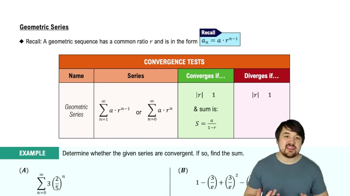
A series is divergent if its sequence of partial sums does not approach a finite limit. This means the sum grows without bound or oscillates indefinitely, so it does not converge to a specific value.
Recommended video:
Geometric Series
Scalar Multiplication of Series
Multiplying each term of a series by a nonzero constant c scales the partial sums by c. This operation preserves the nature of convergence or divergence because scaling a divergent sequence by a nonzero factor cannot produce convergence.
Recommended video:
Geometric Series
Properties of Limits and Series
The limit of a sequence multiplied by a constant equals the constant times the limit of the sequence, if the limit exists. For series, this means if the original series diverges, scaling by a nonzero constant also results in divergence, as the limit of partial sums does not become finite.
Recommended video:
Properties of Functions
Related Practice
Textbook Question
Textbook Question
11–86. Applying convergence tests Determine whether the following series converge. Justify your answers.
∑ (from k = 0 to ∞)3k / ∜(k⁴ + 3)
Textbook Question
13–52. Limits of sequences
Find the limit of the following sequences or determine that the sequence diverges.
{n³⁄(n⁴ + 1)}
Textbook Question
Growth rates of sequences
Use Theorem 10.6 to find the limit of the following sequences or state that they diverge.
{n¹⁰ / ln20n}
1
views
Textbook Question
32–49. Choose your test Use the test of your choice to determine whether the following series converge absolutely, converge conditionally, or diverge.
∑ (from k = 1 to ∞) (−1)ᵏ / k⁰.⁹⁹
Textbook Question
Simplify k! / (k + 2)! for any integer k ≥ 0.
1
views