Explain why the magnitude of the remainder in an alternating series (with terms that are nonincreasing in magnitude) is less than or equal to the magnitude of the first neglected term.

Ch. 10 - Sequences and Infinite Series
Briggs3rd EditionCalculus: Early TranscendentalsISBN: 9780136847243Not the one you use?Change textbook
Chapter 10, Problem 10.8.77
11–86. Applying convergence tests Determine whether the following series converge. Justify your answers.
∑ (from k = 0 to ∞)3k / ∜(k⁴ + 3)
Verified step by step guidance1
First, write down the general term of the series: \(a_k = \frac{3k}{\sqrt[4]{k^4 + 3}}\).
Next, analyze the behavior of the term \(a_k\) as \(k\) approaches infinity to understand if the terms approach zero, which is necessary for convergence.
Simplify the denominator for large \(k\): since \(k^4\) dominates \(3\), approximate \(\sqrt[4]{k^4 + 3} \approx \sqrt[4]{k^4} = k\).
Using this approximation, the term behaves like \(a_k \approx \frac{3k}{k} = 3\) for large \(k\), which does not approach zero.
Since the terms \(a_k\) do not approach zero, by the Test for Divergence (also called the nth-term test), the series \(\sum_{k=0}^\infty \frac{3k}{\sqrt[4]{k^4 + 3}}\) diverges.

Verified video answer for a similar problem:
This video solution was recommended by our tutors as helpful for the problem above.
Video duration:
2mWas this helpful?
Key Concepts
Here are the essential concepts you must grasp in order to answer the question correctly.
Convergence of Infinite Series
An infinite series converges if the sequence of its partial sums approaches a finite limit. Determining convergence involves analyzing the behavior of the terms as the index grows large, ensuring the sum does not diverge to infinity or oscillate indefinitely.
Recommended video:
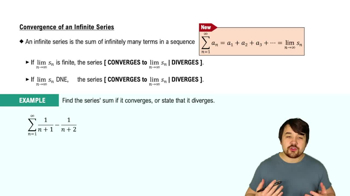
Convergence of an Infinite Series
Comparison and Limit Comparison Tests
These tests compare the given series to a known benchmark series to determine convergence. The Comparison Test uses inequalities, while the Limit Comparison Test uses the limit of the ratio of terms, helping to conclude convergence or divergence by relating to simpler series like p-series.
Recommended video:
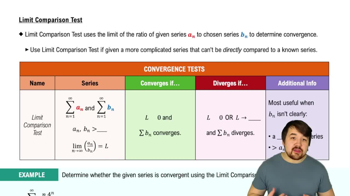
Limit Comparison Test
Asymptotic Behavior of Terms
Understanding how the terms behave for large indices is crucial. Simplifying expressions like 3k / ∜(k⁴ + 3) to dominant terms (e.g., 3k / k) helps identify the series' growth rate and guides the choice of appropriate convergence tests.
Recommended video:
Asymptotes of Hyperbolas
Related Practice
Textbook Question
Textbook Question
13–52. Limits of sequences
Find the limit of the following sequences or determine that the sequence diverges.
{n³⁄(n⁴ + 1)}
Textbook Question
Growth rates of sequences
Use Theorem 10.6 to find the limit of the following sequences or state that they diverge.
{n¹⁰ / ln20n}
1
views
Textbook Question
Property of divergent series Prove Property 2 of Theorem 10.8: If ∑ aₖ diverges, then ∑ caₖ also diverges, for any real number c ≠ 0.
Textbook Question
9–36. Comparison tests Use the Comparison Test or the Limit Comparison Test to determine whether the following series converge.
∑ (k = 1 to ∞) sin(1 / k) / k²
Textbook Question
32–49. Choose your test Use the test of your choice to determine whether the following series converge absolutely, converge conditionally, or diverge.
∑ (from k = 1 to ∞) (−1)ᵏ / k⁰.⁹⁹