Ch. 10 - Sequences and Infinite Series
Briggs - Calculus: Early Transcendentals 3rd Edition
Briggs3rd EditionCalculus: Early TranscendentalsISBN: 9780136847243Not the one you use?Change textbook
Chapter 10, Problem 10.3.45

Periodic doses
Suppose you take 200 mg of an antibiotic every 6 hr. The half-life of the drug (the time it takes for half of the drug to be eliminated from your blood) is 6 hr. Use infinite series to find the long-term (steady-state) amount of antibiotic in your blood. You may assume the steady-state amount is finite.

Verified step by step guidance
1
Identify the problem as a geometric series situation where doses are taken periodically and the drug decays exponentially between doses. The half-life of 6 hours means the drug amount halves every 6 hours, which matches the dosing interval.
Express the amount of drug remaining from each dose at the time just before the next dose is taken. Since the half-life is 6 hours, the decay factor per 6 hours is \(r = \frac{1}{2}\).
Write the total steady-state amount of drug in the blood as the sum of an infinite geometric series where the first term \(a\) is the initial dose of 200 mg, and each subsequent term is multiplied by \(r = \frac{1}{2}\) to represent the remaining drug from previous doses.
Set up the infinite series as \(S = 200 + 200 \times \frac{1}{2} + 200 \times \left(\frac{1}{2}\right)^2 + 200 \times \left(\frac{1}{2}\right)^3 + \cdots\) and recognize this as a geometric series with first term \(a = 200\) and common ratio \(r = \frac{1}{2}\).
Use the formula for the sum of an infinite geometric series \(S = \frac{a}{1 - r}\), where \(|r| < 1\), to express the steady-state amount of antibiotic in the blood.

Verified video answer for a similar problem:

This video solution was recommended by our tutors as helpful for the problem above.
Video duration:
2m
Was this helpful?

Key Concepts

Here are the essential concepts you must grasp in order to answer the question correctly.

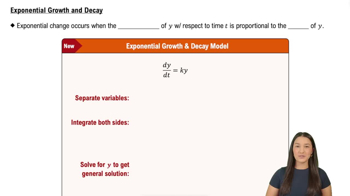
Half-Life and Exponential Decay

Half-life is the time required for a quantity to reduce to half its initial value, commonly used to describe drug elimination. Exponential decay models this process mathematically, where the amount remaining after each half-life is halved. Understanding this helps calculate how much drug remains in the bloodstream over time.
Recommended video:
09:29
Exponential Growth & Decay

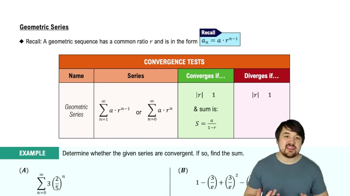
Geometric Series and Infinite Sums

A geometric series is a sum of terms where each term is a constant multiple (common ratio) of the previous one. Infinite geometric series converge to a finite sum if the common ratio's absolute value is less than one. This concept is essential to model the accumulation of drug doses over time and find the steady-state amount.
Recommended video:
06:00
Geometric Series

Steady-State Concentration in Pharmacokinetics

Steady-state concentration occurs when the amount of drug administered equals the amount eliminated over a dosing interval, resulting in a constant average drug level. Calculating this involves summing the residual amounts from all previous doses, often using infinite series, to determine the long-term drug concentration in the blood.
Recommended video:
03:38
Intro to Continuity Example 1