
Textbook Question
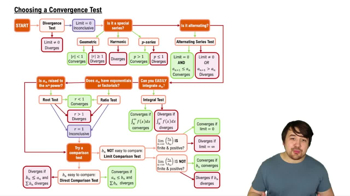
45–63. Absolute and conditional convergence Determine whether the following series converge absolutely, converge conditionally, or diverge.
∑ (k = 1 to ∞) (−1)ᵏ · k / (2k + 1)

 Verified step by step guidance
 07:51
07:51 07:51
07:51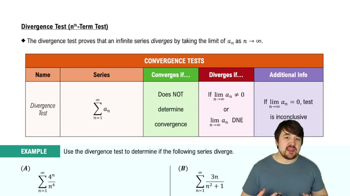 05:44
05:4445–63. Absolute and conditional convergence Determine whether the following series converge absolutely, converge conditionally, or diverge.
∑ (k = 1 to ∞) (−1)ᵏ · k / (2k + 1)
46–53. Decimal expansions
Write each repeating decimal first as a geometric series and then as a fraction (a ratio of two integers).
53.0.00952̅ = 0.00952952…
Growth rates of sequences
Use Theorem 10.6 to find the limit of the following sequences or state that they diverge.
{n¹⁰⁰⁰ / 2ⁿ}
Periodic doses
Suppose you take 200 mg of an antibiotic every 6 hr. The half-life of the drug (the time it takes for half of the drug to be eliminated from your blood) is 6 hr. Use infinite series to find the long-term (steady-state) amount of antibiotic in your blood. You may assume the steady-state amount is finite.
40–62. Choose your test Use the test of your choice to determine whether the following series converge.
∑ (k = 2 to ∞) (5lnk) / k
9–15. Geometric sums Evaluate each geometric sum.
{Use of Tech}∑ k = 0 to 9(−3/4)ᵏ