Ch. 10 - Sequences and Infinite Series
Briggs - Calculus: Early Transcendentals 3rd Edition
Briggs3rd EditionCalculus: Early TranscendentalsISBN: 9780136847243Not the one you use?Change textbook
Chapter 10, Problem 10.2.83d

Explain why or why not
Determine whether the following statements are true and give an explanation or counterexample.


d.If {aₙ} = {1, ½, ⅓, ¼, ⅕, …} and
{bₙ} = {1, 0, ½, 0, ⅓, 0, ¼, 0, …},
then limₙ→∞aₙ = limₙ→∞bₙ.

Verified step by step guidance
1
Step 1: Identify the sequences given. The sequence \( \{a_n\} = \left\{1, \frac{1}{2}, \frac{1}{3}, \frac{1}{4}, \frac{1}{5}, \ldots \right\} \) and the sequence \( \{b_n\} = \left\{1, 0, \frac{1}{2}, 0, \frac{1}{3}, 0, \frac{1}{4}, 0, \ldots \right\} \).
Step 2: Recall the definition of the limit of a sequence. A sequence \( \{x_n\} \) converges to a limit \( L \) if for every \( \epsilon > 0 \), there exists an \( N \) such that for all \( n > N \), \( |x_n - L| < \epsilon \).
Step 3: Analyze the limit of \( \{a_n\} \). Since \( a_n = \frac{1}{n} \), as \( n \to \infty \), \( a_n \to 0 \) because the terms get arbitrarily close to zero.
Step 4: Analyze the limit of \( \{b_n\} \). Notice that \( b_n \) alternates between terms of the form \( \frac{1}{k} \) (for odd indices) and 0 (for even indices). Consider the subsequences: \( b_{2k-1} = \frac{1}{k} \) and \( b_{2k} = 0 \). Both subsequences tend to 0 as \( k \to \infty \).
Step 5: Conclude that since both subsequences of \( \{b_n\} \) tend to 0, the entire sequence \( \{b_n\} \) converges to 0. Therefore, \( \lim_{n \to \infty} a_n = \lim_{n \to \infty} b_n = 0 \).

Verified video answer for a similar problem:

This video solution was recommended by our tutors as helpful for the problem above.
Video duration:
3m
Was this helpful?

Key Concepts

Here are the essential concepts you must grasp in order to answer the question correctly.

Limit of a Sequence

The limit of a sequence is the value that the terms of the sequence approach as the index n goes to infinity. If the terms get arbitrarily close to a specific number, the sequence is said to converge to that limit. Understanding this helps determine if two sequences share the same limit.
Recommended video:
Guided course
8:22
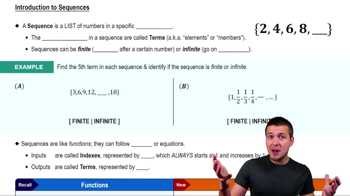
Introduction to Sequences

Behavior of Subsequences

A subsequence is a sequence derived by selecting terms from the original sequence without changing their order. The limit of a sequence must be consistent with the limits of all its subsequences. If subsequences have different limits, the original sequence does not converge.
Recommended video:
03:07
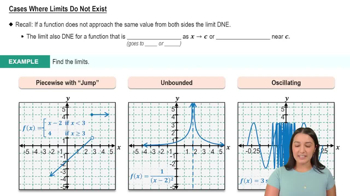
Cases Where Limits Do Not Exist

Zero Terms in a Sequence and Their Impact on Limits

Introducing zero terms intermittently in a sequence can affect its limit behavior. If zeros appear infinitely often and do not approach the original sequence's limit, the overall sequence may fail to converge or converge to a different limit. This concept is key to comparing the limits of {aₙ} and {bₙ}.
Recommended video:
Guided course
5:17
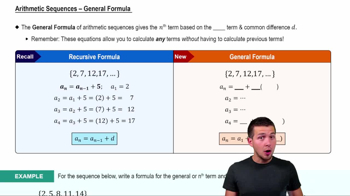
Arithmetic Sequences - General Formula
Related Practice
Textbook Question

87. Explain why or why not

Determine whether the following statements are true and give an explanation or counterexample.


e. ∑ (k = 1 to ∞) (π / e)⁻ᵏ is a convergent geometric series.

Textbook Question

41–44. {Use of Tech} Remainders and estimates Consider the following convergent series.


d. Find an interval in which the value of the series must lie if you approximate it using ten terms of the series.


41. ∑ (k = 1 to ∞) 1 / k⁶

Textbook Question

Explain why or why not Determine whether the following statements are true and give an explanation or counterexample.

d. When applying the Limit Comparison Test, an appropriate comparison series for ∑ (k = 1 to ∞) (k² + 2k + 1) / (k⁵ + 5k + 7) is ∑ (k = 1 to ∞) 1 / k³.

Textbook Question

Explain why or why not Determine whether the following statements are true and give an explanation or counterexample.

e. If ∑ k⁻ᵖ converges, then ∑ k⁻ᵖ⁺⁰.⁰⁰¹ converges.

Textbook Question

72–75. {Use of Tech} Practical sequences

Consider the following situations that generate a sequence


d.Using a calculator or a graphing utility, estimate the limit of the sequence or state that it does not exist.


Radioactive decay

A material transmutes 50% of its mass to another element every 10 years due to radioactive decay. Let Mₙ be the mass of the radioactive material at the end of the nᵗʰ decade, where the initial mass of the material is M₀ = 20g.

Textbook Question

87. Explain why or why not

Determine whether the following statements are true and give an explanation or counterexample.


d. If ∑ pᵏ diverges, then ∑ (p + 0.001)ᵏ diverges, for a fixed real number p.