
Textbook Question
87. Explain why or why not
Determine whether the following statements are true and give an explanation or counterexample.
e. ∑ (k = 1 to ∞) (π / e)⁻ᵏ is a convergent geometric series.

 Verified step by step guidance
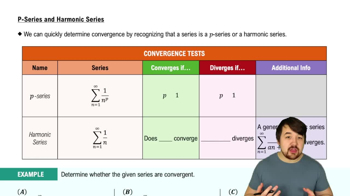
 04:30
04:30
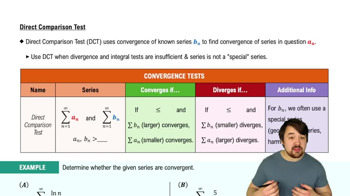 09:25
09:25 5:50
5:5087. Explain why or why not
Determine whether the following statements are true and give an explanation or counterexample.
e. ∑ (k = 1 to ∞) (π / e)⁻ᵏ is a convergent geometric series.
Explain why or why not
Determine whether the following statements are true and give an explanation or counterexample.
f.If the sequence {aₙ} diverges, then the sequence {0.000001aₙ} diverges.
87. Explain why or why not
Determine whether the following statements are true and give an explanation or counterexample.
f. If the series ∑ (k = 1 to ∞) aᵏ converges and |a| < |b|, then the series ∑ (k = 1 to ∞) bᵏ converges.
87. Explain why or why not
Determine whether the following statements are true and give an explanation or counterexample.
d. If ∑ pᵏ diverges, then ∑ (p + 0.001)ᵏ diverges, for a fixed real number p.
Explain why or why not Determine whether the following statements are true and give an explanation or counterexample.
f. If lim (k → ∞) aₖ = 0, then ∑ aₖ converges."
Explain why or why not
Determine whether the following statements are true and give an explanation or counterexample.
d.If {aₙ} = {1, ½, ⅓, ¼, ⅕, …} and
{bₙ} = {1, 0, ½, 0, ⅓, 0, ¼, 0, …},
then limₙ→∞aₙ = limₙ→∞bₙ.