Ch. 10 - Sequences and Infinite Series
Briggs - Calculus: Early Transcendentals 3rd Edition
Briggs3rd EditionCalculus: Early TranscendentalsISBN: 9780136847243Not the one you use?Change textbook
Chapter 10, Problem 10.4.51

48–63. Choose your test Determine whether the following series converge or diverge using the properties and tests introduced in Sections 10.3 and 10.4.
∑ (k = 1 to ∞) 1 / ( (3k + 1)(3k + 4) )

Verified step by step guidance
1
First, recognize the series given: \( \sum_{k=1}^{\infty} \frac{1}{(3k + 1)(3k + 4)} \). This is an infinite series with positive terms, so we can consider tests for convergence of positive term series.
Next, try to simplify the general term using partial fraction decomposition. Express \( \frac{1}{(3k + 1)(3k + 4)} \) as \( \frac{A}{3k + 1} + \frac{B}{3k + 4} \) and solve for constants \( A \) and \( B \).
After finding \( A \) and \( B \), rewrite the series as \( \sum_{k=1}^{\infty} \left( \frac{A}{3k + 1} + \frac{B}{3k + 4} \right) \). This often leads to a telescoping series where many terms cancel out.
Identify the telescoping pattern by writing out the first few terms explicitly and observe how terms cancel when summed.
Finally, use the telescoping property to find the partial sums and analyze their limit as \( n \to \infty \). If the limit exists and is finite, the series converges; otherwise, it diverges.

Verified video answer for a similar problem:

This video solution was recommended by our tutors as helpful for the problem above.
Video duration:
7m
Was this helpful?

Key Concepts

Here are the essential concepts you must grasp in order to answer the question correctly.

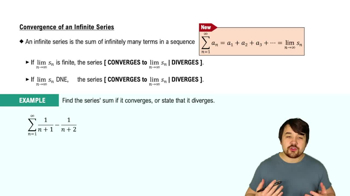
Convergence and Divergence of Infinite Series

An infinite series converges if the sum of its terms approaches a finite limit as the number of terms grows indefinitely. Otherwise, it diverges. Understanding this concept is fundamental to analyzing whether a given series sums to a finite value or not.
Recommended video:
06:52
Convergence of an Infinite Series

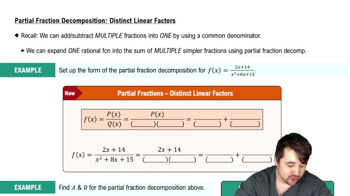
Partial Fraction Decomposition

Partial fraction decomposition breaks a complex rational expression into simpler fractions that are easier to sum or analyze. For series with terms like 1/((3k+1)(3k+4)), this technique helps rewrite terms to identify telescoping behavior or apply known convergence tests.
Recommended video:
10:07
Partial Fraction Decomposition: Distinct Linear Factors

Telescoping Series Test

A telescoping series is one where many terms cancel out when the partial sums are expanded, simplifying the limit evaluation. Recognizing telescoping patterns after decomposition allows for straightforward determination of convergence by examining the remaining terms.
Recommended video:
10:54
Alternating Series Test